The Ancient Tea Horse Road: A Millennium-Long Network That Carried Chinese Tea Outward
Introduction
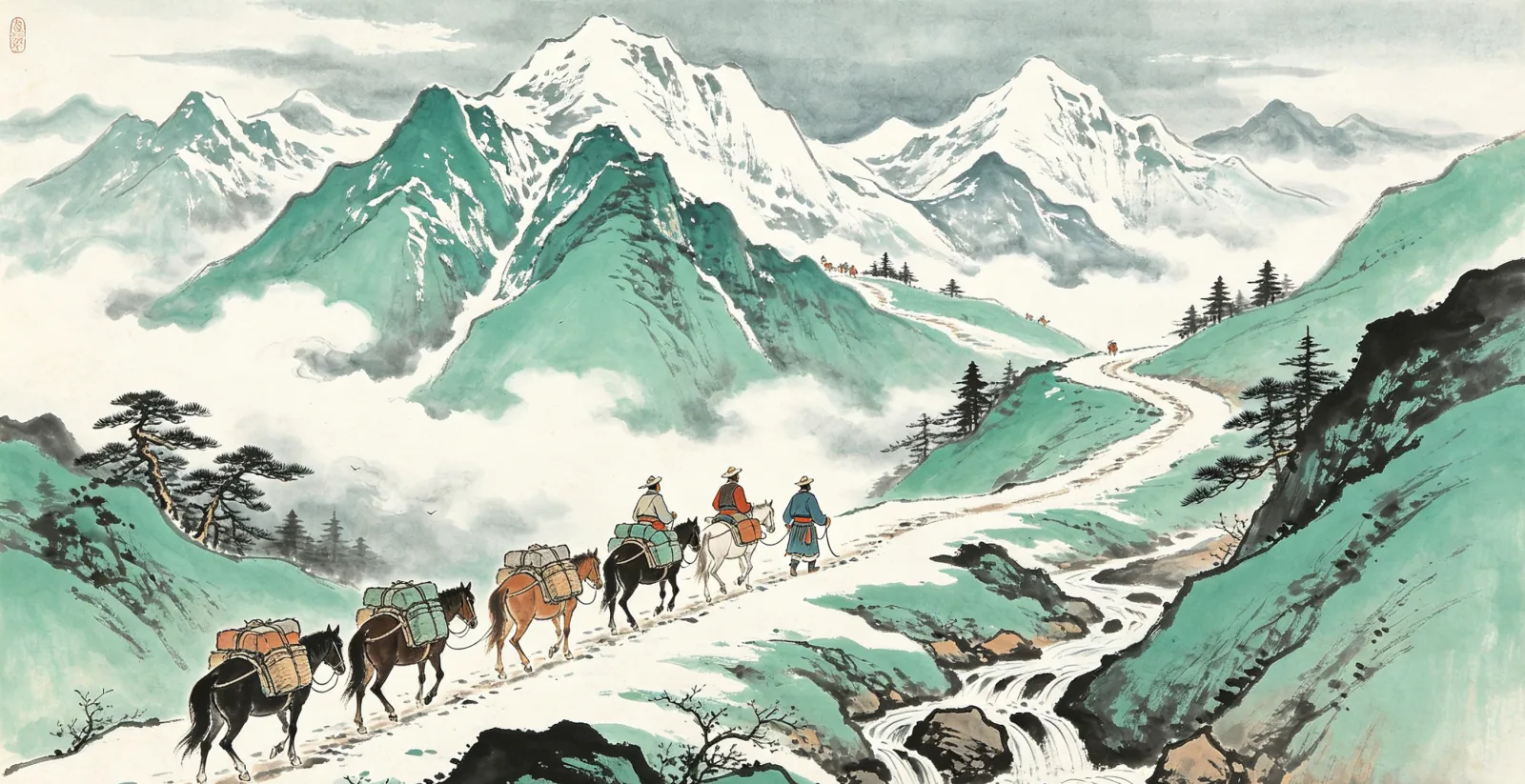
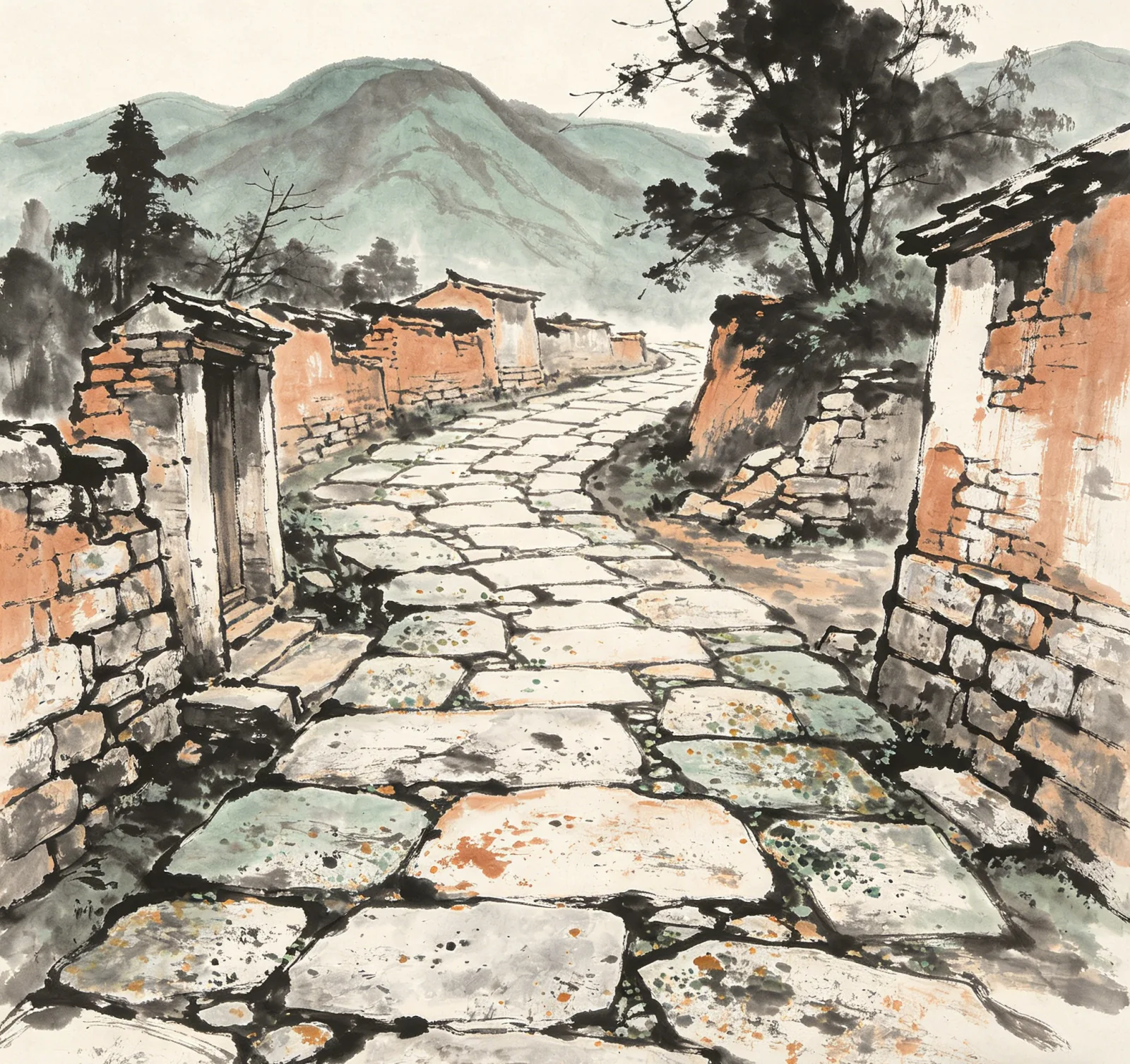
If you walk through the old streets of Pu'er or Lijiang in Yunnan, or Ya'an in Sichuan, you can still see deep round depressions worn into the stone paving. They are hoofprints, ground in over centuries by the horses and mules of caravans that hauled bricks, cakes, and rounds of pressed tea out of the southwestern Chinese mountains. The caravans climbed over snow-capped passes and carried tea to Lhasa, on to Kathmandu, and farther still into Central and South Asia.
This is the Ancient Tea Horse Road.
The Tea Horse Road is not, however, a single road. It is a vast trade network across China's southwest that linked the Tibetan plateau to South Asia, and the earliest large-scale path along which Chinese tea radiated outward into the world. If Song whisked tea carried Chinese tea east into Japan, and Wuyi black tea carried it west into Europe, the Tea Horse Road carried it deep into the interior of Asia.
1. What Exactly Was the Tea Horse Road?
1.1 A network, not a single road
A common misconception is that the Tea Horse Road is a specific, mappable road. In fact it was a trade network — several main lines and countless branches — spanning roughly 4,000 kilometers and connecting the modern provinces of Yunnan, Sichuan, Tibet, Qinghai, and Gansu, then extending outward into Burma, Nepal, India, and parts of Central Asia.
1.2 Three main lines
Scholars usually describe the network in terms of three principal routes:
- The Yunnan–Tibet line: from Pu'er and Xishuangbanna in Yunnan, through Dali, Lijiang, and Deqin, across the Meili Snow Mountains, and on to Lhasa
- The Sichuan–Tibet line: from Ya'an and Kangding (the historical Dajianlu) in Sichuan, through Litang and Batang, into Tibet — the largest official tea-horse trade route in Chinese history
- The Qinghai–Tibet line: from Shaanxi and Gansu through Huangyuan and Xining in Qinghai, into northern Tibet — the main route for the official Ming and Qing tea-horse trade
None of these "lines" was straight. They constantly branched, recombined, and shifted with the seasons, politics, and terrain.
1.3 The name itself is surprisingly young
The trade network is more than a thousand years old, but the term Tea Horse Road as a unifying scholarly concept dates only to 1990. It was coined by a small group of scholars in Yunnan, led by Mu Jihong and Chen Baoya, to describe this cross-regional, cross-ethnic, cross-cultural transport system as a single object. Before that, different segments had different local names — Yunnan–Tibet Tea Horse Road, Southern Border Tea Route, and so on.
2. Why Did the Tea Horse Road Exist?
2.1 Why the highlands needed tea
The Tibetan plateau averages over 4,000 meters in altitude. The traditional diet is heavy in meat, dairy, and tsampa (roasted barley flour), with very few vegetables and limited dietary fiber. Tea aids the digestion of fats, supplements vitamins, and helps mitigate the effects of altitude. It is not a luxury on the plateau; it is a physiological necessity.
A Tibetan saying captures this: "Better to go three days without grain than one day without tea." It is not an exaggeration.
2.2 Why the heartland needed horses
From the Tang and Song onward, Chinese central dynasties had a chronic shortage of strong cavalry horses, while the Tibetan plateau and the mountains of Sichuan and Yunnan produced excellent high-altitude pack horses. Horses were the central strategic resource of pre-modern warfare, and the court had every reason to want a stable supply.
2.3 The institutional birth of the tea-for-horses system
Records of tea moving westward exist from the Tang. The New Book of Tang records a famous moment when a Tibetan envoy in Chang'an saw a wide range of Chinese teas and remarked on their variety:
— New Book of Tang, 'Tubo'This one is from Shouzhou, this from Shuzhou, this from Guzhu, this from Qimen, this from Changming, this from Yonghu...
By the Song, the court formally established a Tea Horse Bureau to handle tea-for-horse exchange. The Ming dynasty institutionalized the system at its peak. The Ming history records the logic plainly:
— Ming Shi, 'Treatise on Food and Money'The frontier peoples are fond of dairy. Without tea, they fall ill. Hence from the Tang and Song, the practice of trading tea for horses has been observed.
This was a system rooted in mutual necessity, and that mutual necessity is the deepest reason the Tea Horse Road operated continuously for over a thousand years.
3. What Kind of Tea Was Carried Along the Road?
3.1 Not loose-leaf grade tea, but pressed tea
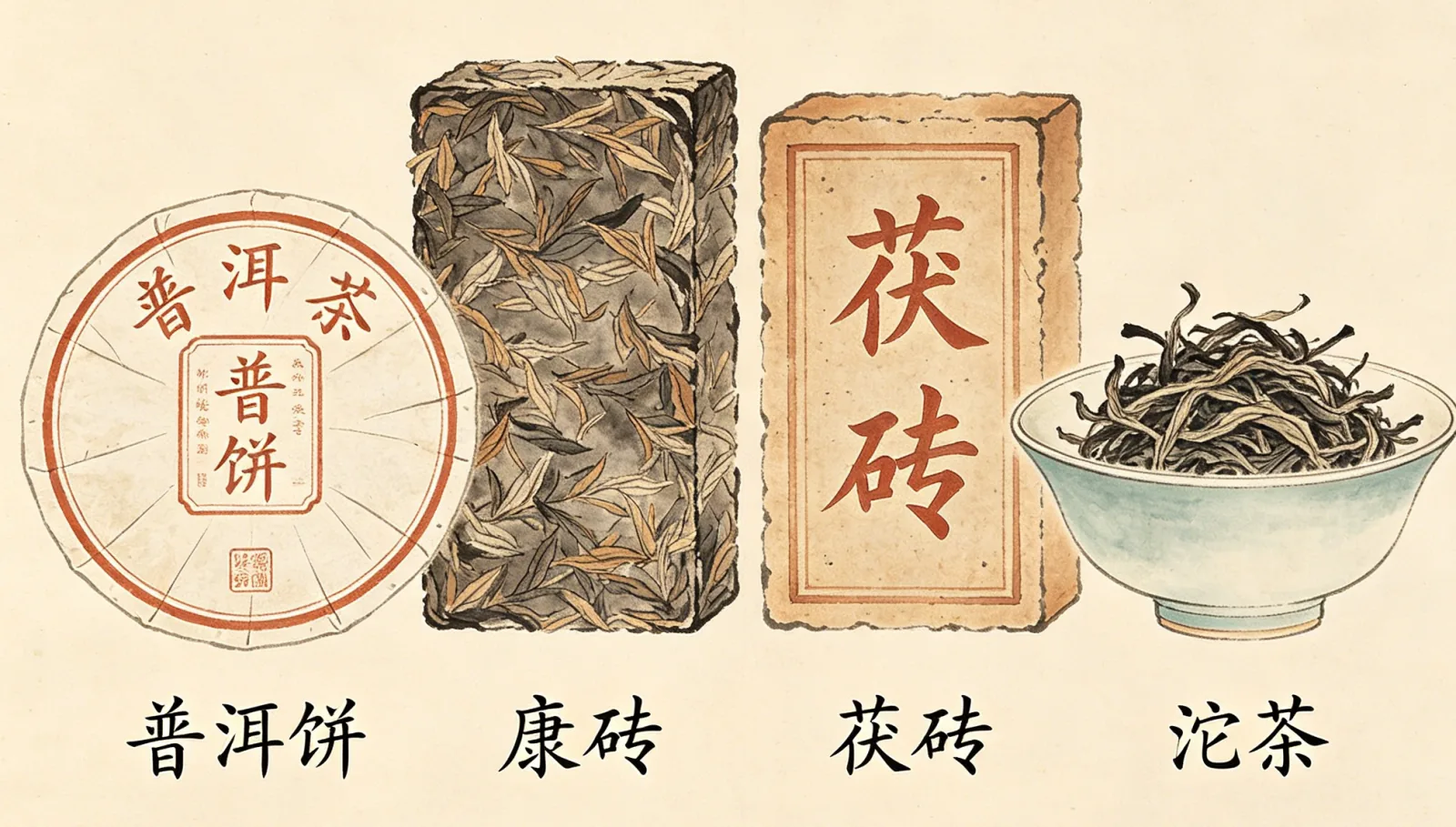
This point matters. The Tea Horse Road never carried fine loose-leaf teas like Longjing or Biluochun. It carried pressed tea — bricks, cakes, and rounds. There were three reasons:
- Durability in transit: pressed forms are compact and resistant to crushing, well suited to long-distance pack-horse travel
- Long-term storage: pressed tea resists spoilage in humid, warm conditions, and in fact develops more complex flavor over time
- Standardized exchange: bricks, cakes, and rounds came in fixed weights, useful as units of value in border trade
3.2 Three main families of "border tea"
Tea produced specifically for the frontier trade was historically called bian cha — "border tea." It came in three main types:
- Yunnan tea: Pu'er cakes and tuocha (rounds) from Pu'er and Menghai, traveling the Yunnan–Tibet line
- Sichuan tea: the Southern Border Tea of Ya'an, including kang zhuan and jin jian bricks, traveling the Sichuan–Tibet line
- Hunan tea: fu zhuan and hei zhuan bricks from Anhua in Hunan, mostly traveling the Qinghai–Tibet line and supplying the northwest
3.3 Why did Pu'er rise as a luxury today?
The "aged Pu'er" market that has driven prices to extraordinary levels in recent decades is, at root, a product of the Tea Horse Road. Yunnan pressed tea naturally fermented during long-distance transport, developing what the trade calls chen xiang — "aged fragrance." Later, this aging quality was deliberately amplified and standardized, producing the modern shou pu'er ("ripe Pu'er") process, and Pu'er rose from a frontier commodity into a high-end collectible.
In a real sense, without the Tea Horse Road, there would be no "Pu'er" as we know it today.
4. The Rise and Fall of a Thousand-Year Trade
4.1 Tang and Song: institutional beginnings
Scattered records of tea-horse exchange already appear in the Tang. The Song formally established Tea Horse Bureaus and codified the ma jia cha fa — "horses-priced-in-tea law" — making tea-for-horses a state monopoly. Under heavy military pressure from Western Xia and Liao, the Northern Song treated tea-for-horse trade as a vital defense supply mechanism.
4.2 Ming: the institutional peak
The Ming represents the high point of formalized Tea Horse Road operations. Multiple Tea Horse Bureaus were set up across Sichuan and Shaanxi. Tea-for-horses was written into law, and unauthorized smuggling of tea to the frontier could be punished by death. Official transport along the Sichuan–Tibet line during this period reached significant volumes.
4.3 Qing: from official monopoly to private commerce
In the Qing, the official monopoly weakened, but trade volume did not decline. It expanded. Pu'er Prefecture in Yunnan grew into a major collection and dispatch hub, and the place name "Pu'er" gradually attached itself to the tea itself. In this period, private caravans (ma bang) reached their highest level of activity, supporting a distinct professional caravan culture.
4.4 Wartime: one last surge
In the late 1930s and early 1940s, with coastal ports blockaded during the Sino-Japanese War, the Tea Horse Road and the Burma Road took on emergency wartime roles. Caravans hauled strategic supplies into China, and the road experienced a final, unexpected revival.
4.5 After the 1950s: replaced by modern transport
After 1949, the Sichuan–Tibet, Qinghai–Tibet, and Yunnan–Tibet highways were built in succession, and trucks gradually displaced caravans. By the 1960s, the Tea Horse Road had effectively retired from the modern transportation system.
5. The Tea Horse Road Today: From Trade Route to Cultural Heritage
5.1 Scholarly and cultural rediscovery
From the 1990s onward, the Tea Horse Road was retrieved from the edge of historical memory and turned into a major frame for studying southwestern China's ethnic relations, trade history, religious diffusion, and ecological change. Yunnan, Sichuan, and Tibet have all carried out fieldwork, heritage protection, and oral history projects along its routes.
5.2 Tourism and cultural narrative
Cities along the network — Lijiang, Shangri-La, Ya'an, Kangding — now use the Tea Horse Road as a central piece of their cultural identity for visitors. Caravans, caravan songs, pressed tea, and Tibetan-style teahouses have become recurring cultural symbols in this part of China.
5.3 An underrated chapter in the global story of Chinese tea
We have already seen Song whisked tea travel east to Japan and Wuyi black tea travel west to Europe. The Tea Horse Road, which carried tea up onto the Tibetan plateau and outward into South and Central Asia, has been comparatively underrated in Chinese and global tea-history narratives.
Yet judged by geographical reach, duration, and the populations it touched, the Tea Horse Road is the largest and most enduring single channel through which Chinese tea entered the wider world.
To understand the Tea Horse Road, then, is to understand more than an old trade route. It is to see how, in an age before steamships and railroads, a single leaf was carried over the Himalayas on the strength of human and animal feet, and entered cultural worlds far beyond the Chinese heartland.
Sources
- New Book of Tang, "Tubo," Northern Song
- Ming Shi, "Treatise on Food and Money: Tea Law," early Qing
- Xie Zhaozhe, Dian Lue, Ming Wanli era
- Lu Tingcan, Xu Cha Jing (Continuation of the Classic of Tea), Qing Yongzheng era
- Yunnan Tong Zhi (Yunnan Gazetteer), Qing
Classical Sources
- 📜 New Book of Tang
- 📜 Ming Shi: Treatise on Food and Money
- 📜 Dian Lue
- 📜 Xu Cha Jing