Wuyi Rock Tea: Where the 'Rock Rhyme' of Oolong's Birthplace Comes From
Introduction
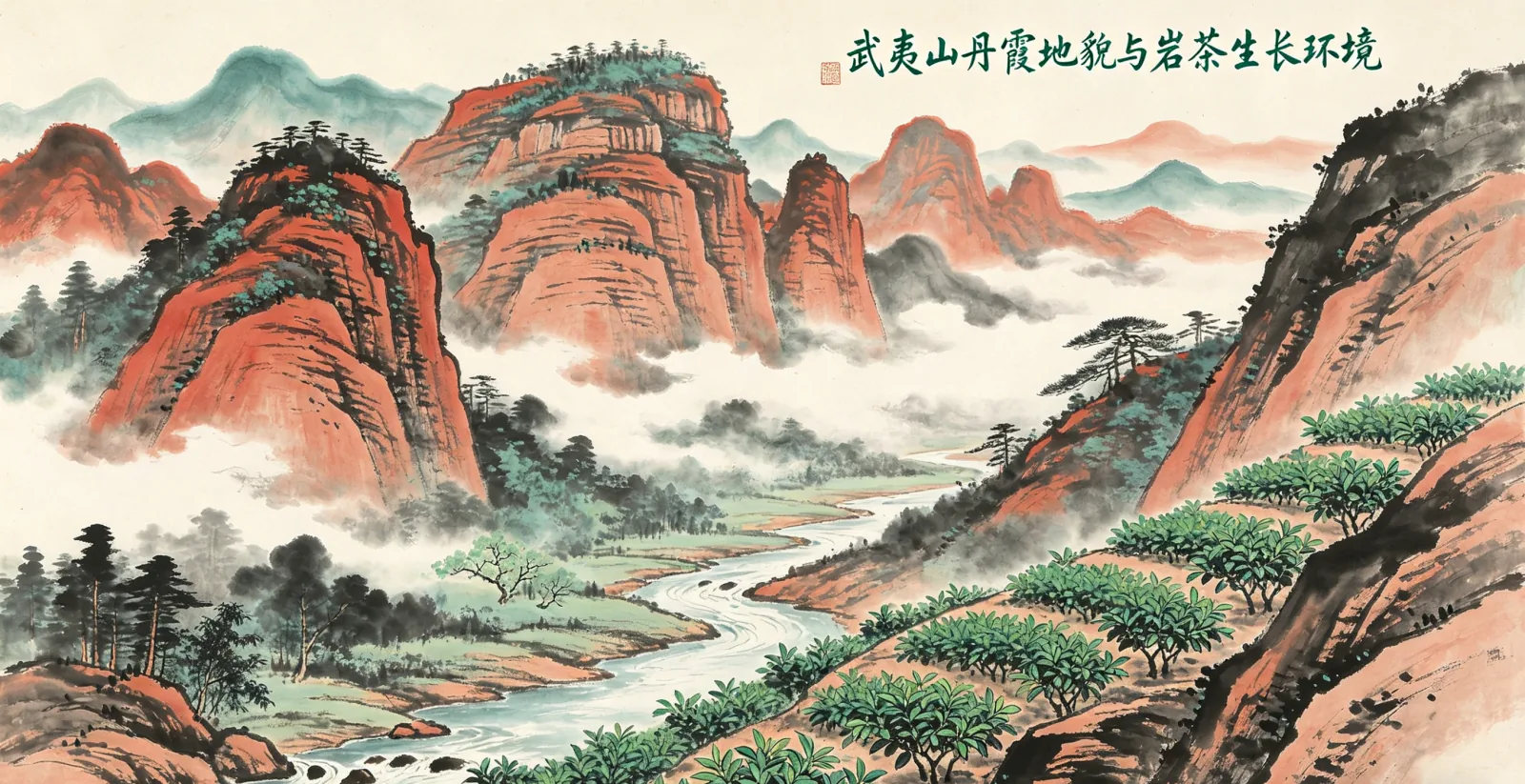
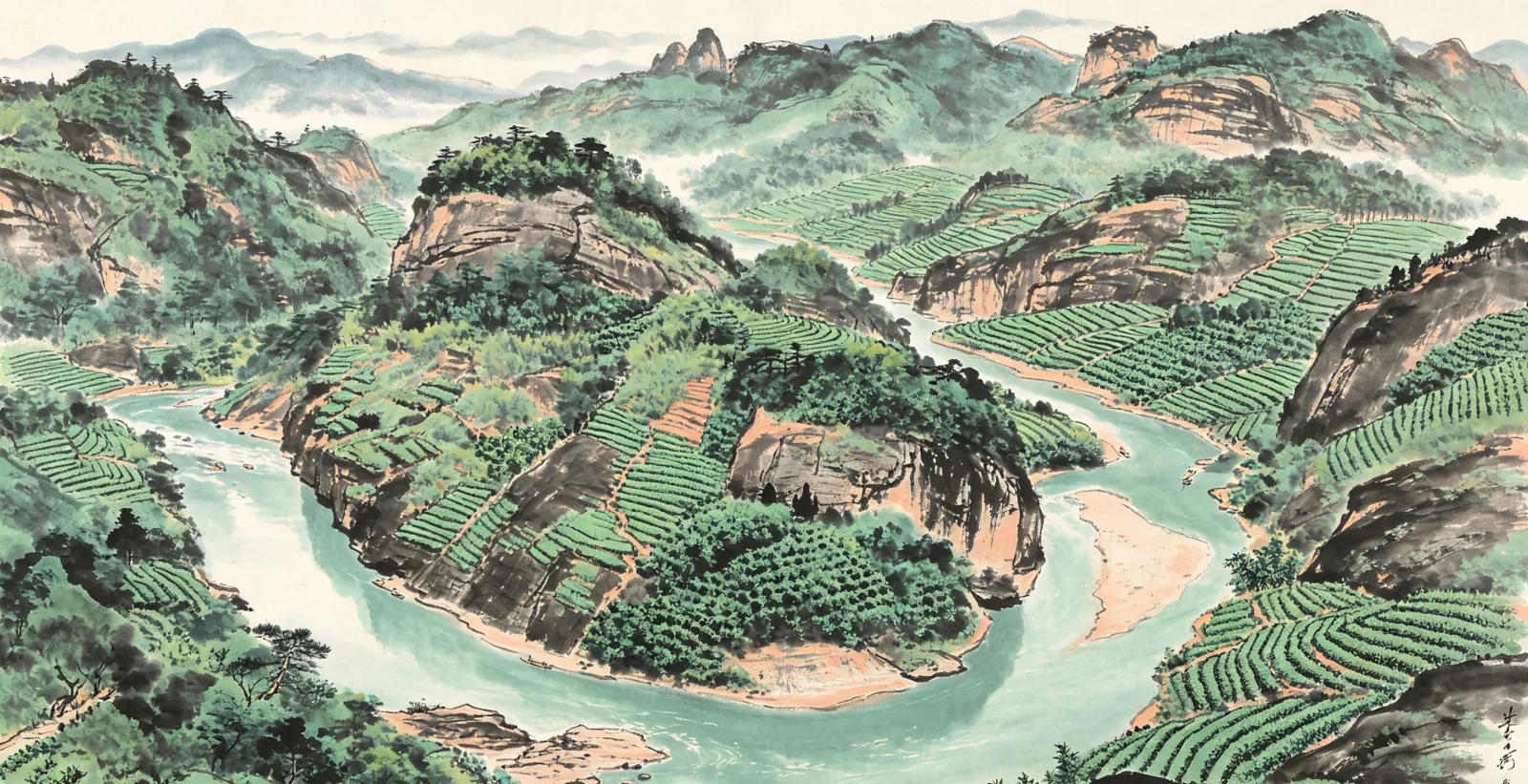
If you stand by the Nine-Bend Stream at Mount Wuyi in Fujian and look up, you will see walls of red sandstone cliffs. In the cracks of those cliffs, on the small slopes between them, weathered into the stone itself, scattered tea bushes grow. They are nothing like the flat, geometric tea fields of most plantations — yet they hold up some of the most complex chapters in the history of Chinese tea.
This is where Wuyi rock tea is grown. Wuyi is not only the birthplace of oolong tea, but also the ancestral home of the world's first black tea. From a single mountain emerged two distinct processes and two distinct flavor worlds, which together shape much of what global drinkers think of when they think of Chinese tea today.
The most prized character of Wuyi rock tea is captured in four Chinese words: yan gu hua xiang — "rock bone, flower fragrance." The "bone" comes from the land. The "fragrance" comes from the craft. To understand both, you have to begin with the rock itself.
1. What Counts as Rock Tea, and Why Is It Different?
1.1 Rock tea is a strict geographical category
"Rock tea" does not mean any tea grown on stones. Only oolong tea produced within the Wuyi rock zone may be called Wuyi rock tea. This is defined and protected by China's geographical indication system.
The most prestigious sub-zone is what tea growers call the Three Pits and Two Streams (san keng liang jian): Huiyuan Pit, Niulan Pit, Daoshui Pit, Liuxiang Stream, and Wuyuan Stream. Tea from these five places is considered to have the strongest "rock rhyme" and commands the highest prices. Tea grown in the surrounding rock zones is called ban yan ("half rock"), and tea from the flat land outside the mountain is called zhou cha ("river tea").
1.2 The mineral depth comes from a Danxia landform
Mount Wuyi is a textbook case of Danxia landform: cliffs of iron-rich red sandstone and conglomerate. Tea bushes grow in cracks, on stone slopes, and in weathered rock beds. Their roots reach into the cliff crevices and absorb minerals leaching out of the stone. This kind of growing environment gives the tea a distinctive heavy, almost stone-like depth on the palate. That is the basis of the "rock bone."
1.3 The microclimate sets up the fragrance
The Wuyi rock zone is wrapped in mist almost year-round, with sharp day-night temperature swings. Tea bushes grow slowly, with thick leaves. The cliffs block direct sunlight, so the bushes receive mostly diffused light, which encourages the accumulation of amino acids and aromatic compounds at higher levels than in flatland tea gardens. That is the material foundation of the "flower fragrance."
2. How Has Wuyi Tea Changed Across History?
Mount Wuyi has produced tea for a long time, but "rock tea" in the modern sense is a relatively recent product. The role of tea on this mountain has shifted at least four times.
2.1 Tang dynasty: a peripheral producer of curd tea
Lu Yu's Classic of Tea already lists Fujian among Tang tea-producing regions:
— Cha Jing, 'Producing Areas'In Lingnan, tea is produced in Fuzhou, Jianzhou, Shaozhou, and Xiangzhou.
But in this period Fujian was not at the center of the Tang tea map. Wuyi tea existed mainly as the steamed and pressed curd cake typical of the Tang.
2.2 Song dynasty: neighbor to the Beiyuan tribute zone
Song Fujian's center of gravity was Beiyuan in Jian'an, the source of the famous dragon and phoenix tribute cakes. Wuyi shared the region, but it was not yet the heart of the tribute system. Fan Zhongyan called Wuyi tea a "rare leaf" in his famous tea-battle poem:
— Fan Zhongyan, 'Battle of Tea'By the stream a rare tea, finest under heaven; the immortals of Wuyi planted it long ago.
2.3 Yuan dynasty: an imperial tea garden was established at Wuyi
After 1279, the Yuan court formally established an Imperial Tea Garden at Mount Wuyi. From this point, Wuyi gained a more secure place inside the imperial tea system.
2.4 Ming and Qing: from steamed to pan-fired to half-oxidized
After the early Ming abolished the cake-tea tribute, tea processing across China shifted toward loose-leaf forms. The most consequential change happened in late Ming and early Qing Wuyi: local growers gradually developed a layered process — withering, zuo qing (literally "doing the green," a controlled oxidation step), pan-firing, and roasting — that placed the resulting tea between fully unoxidized green tea and fully oxidized black tea. This is the prototype of oolong tea.
The early Qing writer Wang Caotang recorded the process clearly in his Cha Shuo:
— Cha Shuo (Wang Caotang, early Qing)After picking, the leaves are spread evenly on bamboo trays, set out under the wind and sun — this is called sun-withering. When the green color begins to retreat, they are pan-fired and roasted. After firing and roasting, the older leaves and stems are removed, so that the lot is uniform.
This is the earliest unambiguous description of oolong-style processing in Chinese tea history. It is why Mount Wuyi is recognized as the birthplace of oolong tea.
3. Why Is Wuyi Rock Tea Called the Ancestor of Oolong?
3.1 The decisive technique: zuo qing
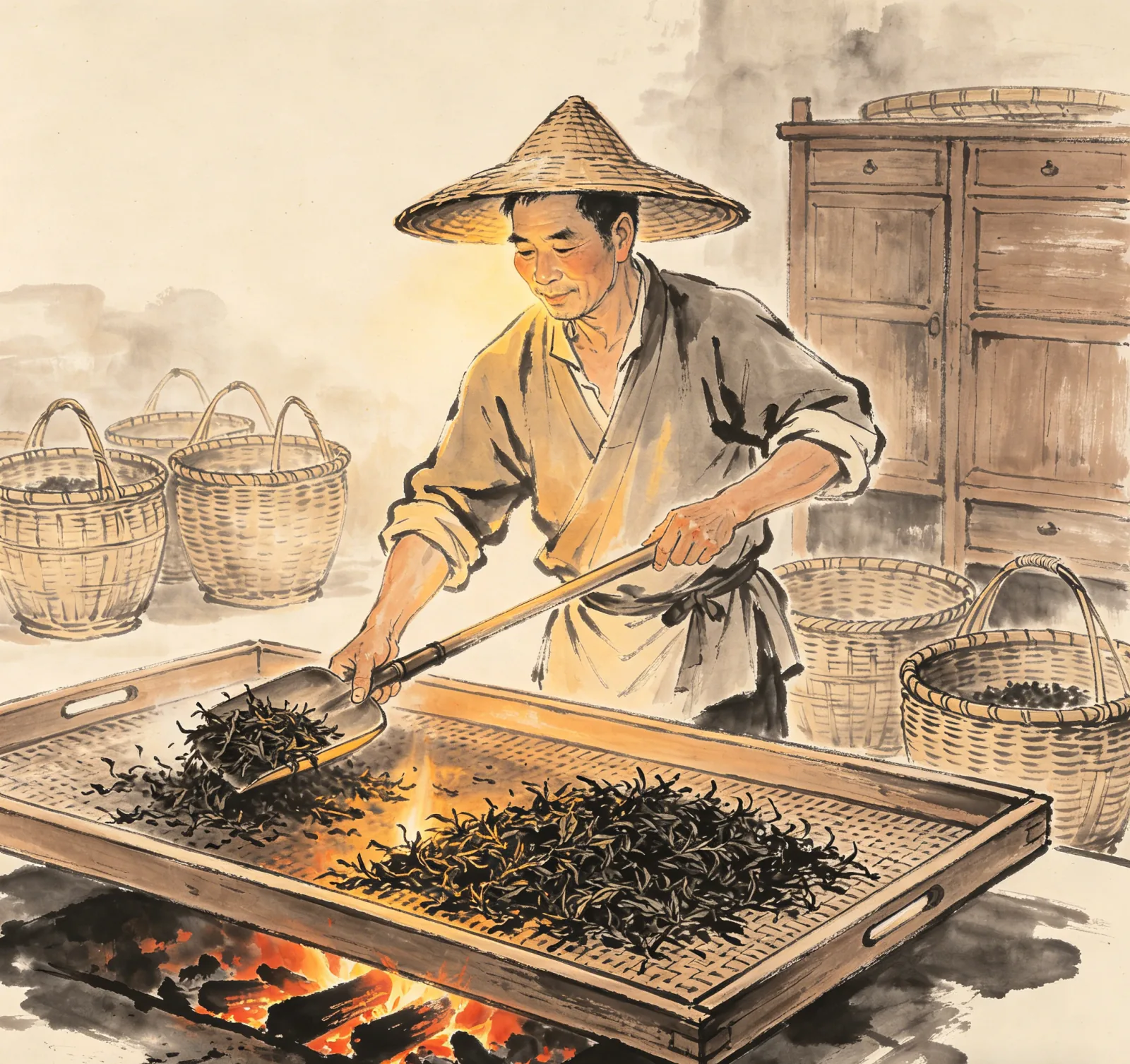
The most distinctive step in rock tea processing is zuo qing — alternating gentle agitation with rest, so that the edges of each leaf undergo controlled oxidation while the center stays relatively green. The classic visible result is "green leaf with red border."
The degree of zuo qing sets the oxidation level of an oolong. Lighter oxidation preserves more floral aroma; heavier oxidation brings out caramel and ripe fruit notes. Traditional rock tea sits in the medium-to-heavy range.
3.2 Roasting: the step that defines rock tea's character
After zuo qing, rolling, and a first drying, rock tea undergoes repeated charcoal roasting, sometimes only once but often three times or more. Roasting is not simply about drying. It is what shifts the tea from sharp to round, from bright to deep. Light, medium, and full roasts produce strikingly different cups from the same leaf.
3.3 The technique radiated outward
This zuo qing and roasting framework spread from Wuyi outward: south to Guangdong, where it produced Phoenix Dancong; east to Taiwan, where it produced Dongding oolong and Oriental Beauty. Almost the entire modern oolong family can trace its processing logic back to Wuyi.
4. The Famous Cultivars and the Idea of "Rock Rhyme"
4.1 What is a "famous cultivar"?
Over centuries of cultivation, Wuyi developed a large set of distinct tea cultivars known as ming cong — "famous cultivars." Each has its own leaf shape, aroma, and character. The most widely known are the Four Great Famous Cultivars:
- Da Hong Pao ("Big Red Robe") — the most famous of all, traditionally tied to a few mother trees on the cliffs of Tianxin Rock
- Tie Luo Han ("Iron Arhat") — said to be one of the earliest cultivars, with a deep aroma
- Bai Ji Guan ("White Cockscomb") — yellow-tinged leaves, a delicate aroma, and a long-running medicinal legend
- Shui Jin Gui ("Golden Water Turtle") — named after a flood that washed the bushes onto a neighbor's land, sparking a famous ownership dispute
4.2 The real volume leaders today
Outside the four classics, two cultivars now dominate market volume: Rou Gui and Shui Xian.
- Rou Gui ("Cassia") — sharp, spicy, and assertive, often described as "powerful"
- Shui Xian ("Narcissus") — round, layered, with quieter aromatics
Tea drinkers sometimes joke that the two words you hear most often in a rock-tea shop are not "Da Hong Pao," but "Rou Gui" and "Shui Xian."
4.3 Da Hong Pao today
The six surviving mother trees of Da Hong Pao at Jiulongke have been protected as cultural heritage since 2006 and are no longer harvested. Almost every "Da Hong Pao" sold today is either a vegetatively propagated descendant of those trees or a careful blend.
The level of protection accorded to a few tea bushes says something about the standing of rock tea. It is rare for any other tea family to elevate individual plants to that status.
4.4 What is "rock rhyme" (yan yun)?
Yan yun is the most discussed and most slippery concept in rock tea. It is usually described as:
- a stone-like, mineral weight on the palate
- a long, structured aftertaste with "bone"
- floral, fruit, and fire notes layered together
- a persistent finish in the mouth and throat after the cup is empty
Rock rhyme is not really an aroma. It is closer to a sense of structure — the joint result of place and craft. Outside the Wuyi rock zone, it is very hard to reproduce.
5. The Other Identity of Mount Wuyi: Birthplace of Black Tea
5.1 Lapsang Souchong: the world's earliest black tea
Around the seventeenth century, growers near Tongmu Pass on Mount Wuyi developed a process unlike anything used for rock tea: full oxidation of the leaves combined with smoke-drying over pinewood. The result was Lapsang Souchong (zhengshan xiaozhong), now generally accepted as the earliest black tea in the world.
5.2 One mountain, two schools
In other words, the two great families of more-than-half-oxidized Chinese tea — oolong and black — both began on the same mountain. A single landscape produced two different tea worlds.
5.3 Early routes overseas
Lapsang Souchong reached Europe through maritime trade and shaped English tea drinking in the seventeenth and eighteenth centuries. The English word "Bohea," once one of the most common names for Chinese tea, is simply a transliteration of "Wuyi."
In the same way that Song whisked tea traveled to Japan and re-rooted as the matcha ceremony, Wuyi black tea traveled to Britain and re-rooted as afternoon tea. Both stories are about Chinese tea radiating outward and taking on a new life in another culture.
To understand Wuyi rock tea, then, is to understand more than one specific Chinese tea. It is to understand how a single mountain can shape two very different drinking cultures, on two different continents.
Sources
- Lu Yu, Cha Jing ("Producing Areas"), late eighth century
- Fan Zhongyan, "Battle of Tea" (He Zhang Min Cong Shi Dou Cha Ge), Northern Song
- Lu Tingcan, Xu Cha Jing (Continuation of the Classic of Tea), Qing Yongzheng era
- Wang Caotang, Cha Shuo (Discourse on Tea), early Qing
- Dong Tiangong, Wuyi Shan Zhi (Gazetteer of Mount Wuyi), Qing Qianlong era
Classical Sources
- 📜 The Classic of Tea
- 📜 Xu Cha Jing
- 📜 Cha Shuo
- 📜 Battle of Tea (Fan Zhongyan)