From Tang Boiling to Song Whisking: Why Song Dynasty Tea Culture Is Often Called a Peak
Introduction
If you have ever seen Japanese matcha being whisked into a bowl of bright green foam, or watched a costume drama scene of two scholars competing over tea, you have already encountered the legacy of Song dynasty tea culture.
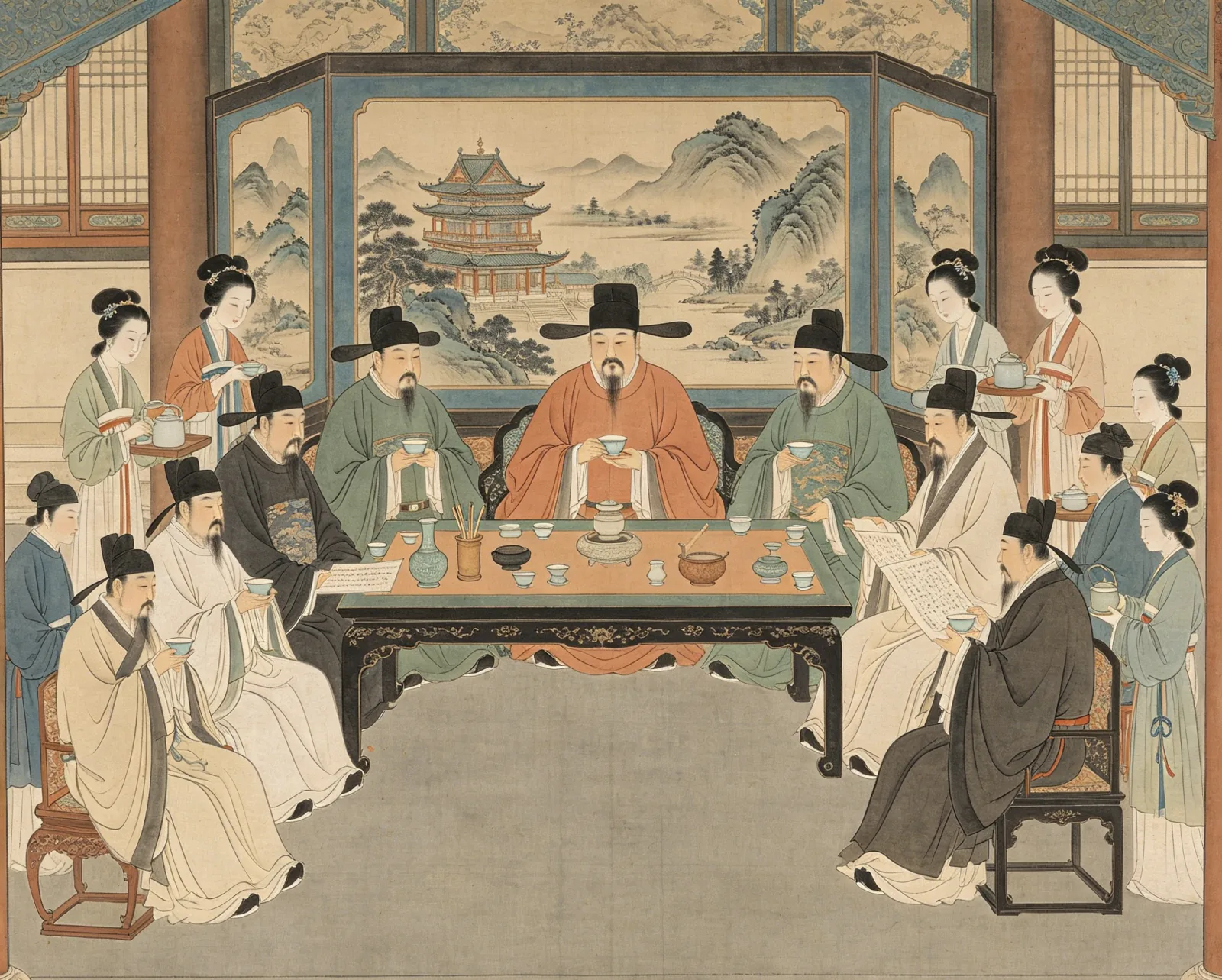
The Tang dynasty made tea into a serious cultural subject, but Tang people still drank tea by boiling it: they ground tea cakes into powder and decocted them in water. The Song dynasty changed this completely. People stopped boiling tea and instead placed the powder directly into a bowl, poured hot water over it, and whisked it into a thick foam with a bamboo whisk. This practice is called dian cha, often translated as "whisked tea" or "spotted tea."
This was not a small adjustment. Whisked tea brought with it a new system of vessels, techniques, aesthetics, and social meaning. It is one of the reasons the Song dynasty occupies such a distinctive place in the history of tea — not only in China, but across East Asia.
1. Why Did the Song Move from Boiling to Whisking?
1.1 Tea cakes became far more refined
Tang tea cakes were comparatively rough, suited to decoction. By the Song, especially in the imperial tribute tea gardens of Beiyuan in Fujian (modern Jian'ou), production techniques had been pushed to an extreme: pressing, grinding the curd, molding, decorating, and slow firing. The most prized tribute cakes — the famous longtuan and fengbing (dragon and phoenix cakes) — were fragments of art rather than ordinary food.
Finer cakes meant finer powder, and finer powder is much better suited to whisking than to boiling. This was, in effect, a craft-level push toward a new way of preparing tea.
1.2 Literati culture rewarded close attention to detail
Song literati treasured the small refinements of daily life. They burned incense, arranged flowers, contemplated rocks, and graded inkstones. Tea naturally entered this world of cultivated attention.
Boiling a pot of tea offers limited room for discrimination. Whisking offered far more: the angle of the wrist, the temperature of the water, the texture of the foam, the speed at which the foam dissolves. Whisked tea became the perfect canvas for an aesthetic culture obsessed with subtle differences.
1.3 An emperor wrote a tea book
The Song imperial house took tea seriously to a degree rarely seen in Chinese history. Emperor Huizong (Zhao Ji) is the extreme case. He did not merely consume tea; he wrote a full treatise on it — Da Guan Cha Lun — the only tea book in Chinese history authored by a sitting emperor.
— Da Guan Cha Lun, PrefaceSince the rise of our dynasty, the tribute of Jianxi has been carefully maintained. The dragon cakes and phoenix cakes are the finest in the world.
Once the emperor declared whisked tea a worthy subject of writing, the entire literate class had every reason to take it seriously.
2. How Was Whisked Tea Actually Prepared?
The standard Song procedure can be divided into two stages: preparing the powder and whisking the bowl.
2.1 Preparing the powder
- Roast the tea cake lightly to remove moisture
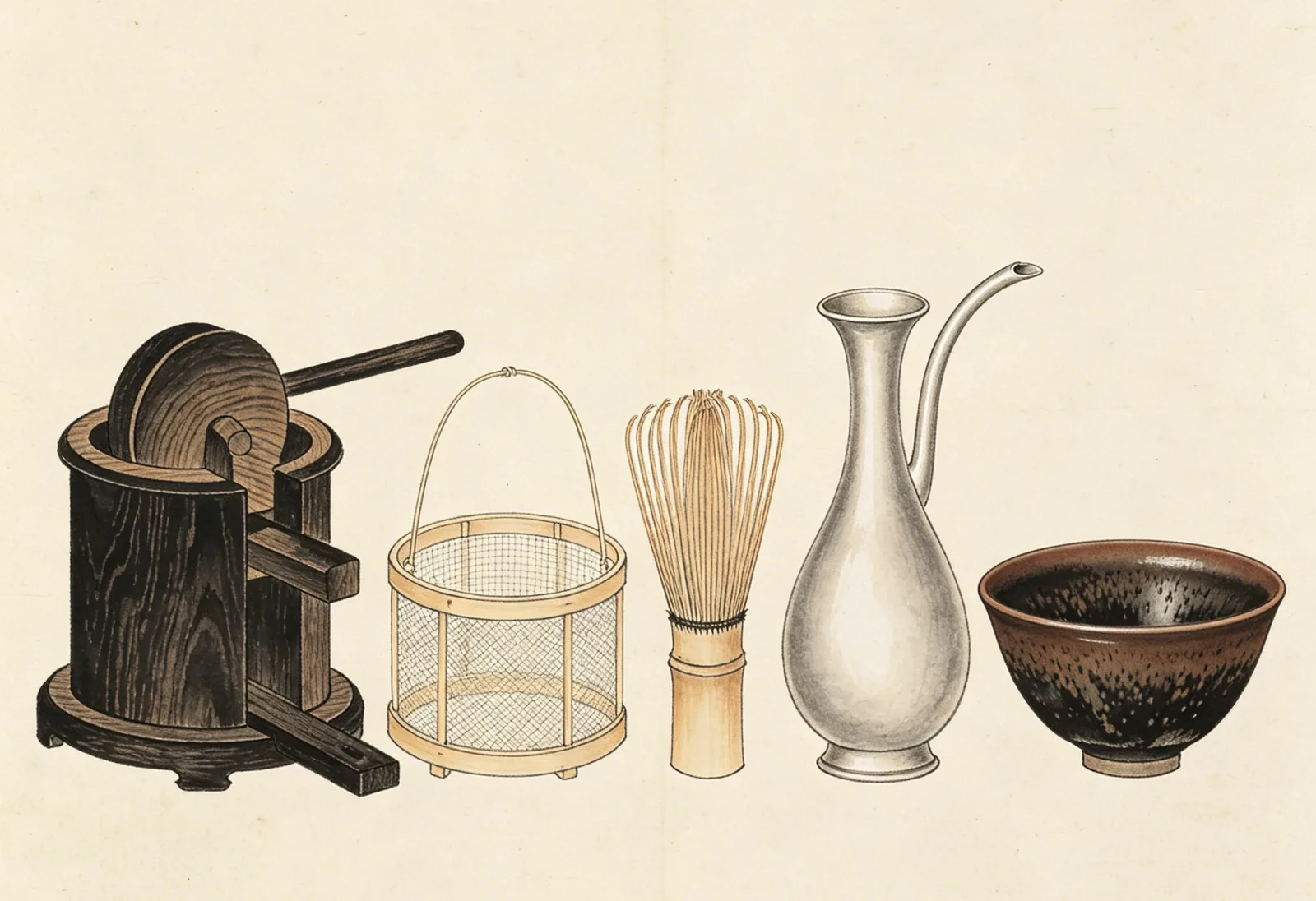
- Grind the cake in a tea mill into a coarse powder
- Sift the powder through a fine silk sieve into a very fine powder
Cai Xiang, the foundational theorist of Song tea, was emphatic about the sifting:
— Cha Lu, 'On Sifting'If the powder is fine enough, the tea will float; if it is coarse, the water will float.
Fine powder allows the foam to rise on top. Coarse powder cannot stay suspended; the water rises through it and the bowl looks muddy.
2.2 Whisking the bowl
- Warm the bowl with hot water so that the temperature does not collapse during whisking
- Form the paste: drop the powder into the bowl and add a small amount of hot water to make a smooth paste
- Pour in stages: hot water is added in multiple rounds (often described as seven)
- Whisk vigorously with a bamboo cha xian whisk after each pour, until a layer of foam forms on the surface
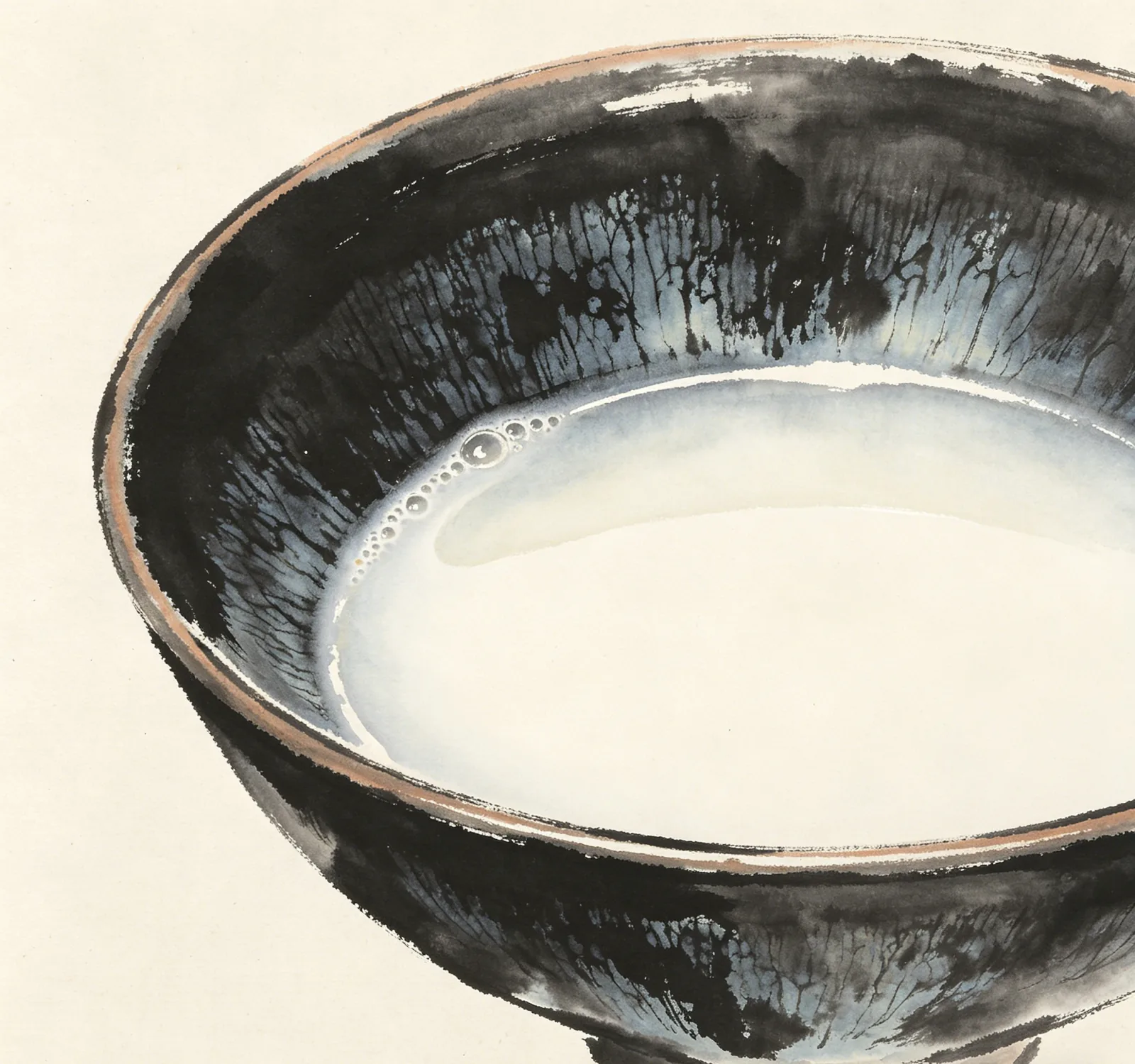
The whisking is the visible, performative part. The whisk moves rapidly through the bowl, the liquid transitions from cloudy to silky, and a layer of "milk flowers" — the prized white foam — settles on top.
2.3 The standard of judgment: read the foam
Song tea drinkers did not simply finish the bowl. They evaluated the foam. Two qualities mattered most:
- Whiteness: the whiter the foam, the better — which is why Song drinkers preferred dark Jian ware bowls, where white foam stood out by contrast
- Persistence: the foam should "bite the bowl," clinging to the inner walls without dissipating quickly. Whichever bowl's foam dispersed first lost the round.
This standard of judgment gave rise to one of the most distinctive Song social practices: dou cha, the tea contest.
3. The Cultural Architecture Behind Whisked Tea
What made Song whisked tea historically important was not merely its technical refinement. It was the way the practice cut across social classes, drawing emperors, scholars, monks, and townspeople into a shared cultural language.
3.1 The court: tea as state aesthetics
Emperor Huizong treated whisked tea almost as an extension of imperial ritual. The Beiyuan tribute system supervised tea production with dedicated officials. The most prized cake, longtuan shengxue ("dragon cake whiter than snow"), was famously valued at two ounces of gold per cake — a luxury beyond even most senior officials.
3.2 Literati: tea as cultivation made visible
Cai Xiang, the leading theorist, was both a celebrated calligrapher and a tea administrator. His Cha Lu is divided into two halves — one on tea and one on its vessels — and became the standard manual for Song whisked tea practice.
The poet Su Shi placed tea directly into his verse:
— Su Shi, 'Boiling Tea by the River'Living water must be boiled with living fire; I myself sit on the fishing rock and draw the deepest, clearest stream.
What literati performed through whisked tea was not technical virtuosity, but a particular spirit: the discipline of taking small things seriously.
3.3 Buddhist monks: tea as extended practice
Chan (Zen) Buddhism flourished in the Song, and many monasteries integrated whisked tea into their daily ritual life. The most famous example is the Jingshan Monastery in Hangzhou, whose ceremonial "Jingshan tea banquet" became a model. Japanese monks such as Eisai and Enni Ben'en, who came to Song China to study, brought this whisked tea practice back to Japan, where it eventually became the heart of the Japanese tea ceremony.
3.4 Townspeople: tea as ordinary entertainment
Whisked tea was not confined to palaces and study halls. The streets of Bianjing (Kaifeng) and Lin'an (Hangzhou) were lined with teahouses. Sources such as Dongjing Meng Hua Lu and Meng Liang Lu record commoners holding tea contests in everyday teahouses. Whisked tea was, in this sense, also part of the urban entertainment of the time.
4. The Vessels of Whisked Tea
Each utensil of Song whisked tea was both a tool and an object of taste.
4.1 Jian ware bowls: black glaze for white foam
To make the white foam stand out, Song drinkers chose black-glazed bowls. Jian ware, fired in the kilns of Jianyang in Fujian, became the favored choice. Its black glaze produces natural crystalline patterns — hare's fur, oil spot, and the rare yohen tenmoku — that Emperor Huizong himself praised as "blue-black is the noblest, and jade-streaked the finest."
4.2 The bamboo whisk: the tool that made foam possible
The cha xian is a single piece of bamboo carved into many fine prongs. Without it, the foam would not form. The same form of whisk is still used today in Japanese tea, a sign of how complete the Song design already was.
4.3 The ewer: precision pouring
Song whisked tea was not poured from large kettles but from narrow-spouted ewers (tang ping). The shape of the spout controlled the force and angle of the water — one of the variables that decided whether the foam would form well.
4.4 The mill and the sieve
The tea mill and sieve existed for one purpose: to make the powder as fine as possible. Even these tools became elegant. The Cha Ju Tu Zan, written by Shen'an Laoren in 1269, anthropomorphized twelve tea utensils and gave them official titles, half in jest, half in tribute.
5. What Did Song Whisked Tea Leave Behind?
5.1 In China, it faded with the cake-tea system
In the early Ming dynasty, the founding emperor Zhu Yuanzhang ordered the abolition of dragon-and-phoenix tribute cakes. The tribute system shifted to loose-leaf tea, and over the next century or so, loose-leaf brewing replaced whisked tea as the dominant Chinese practice.
This means that Song whisked tea did not survive in mainland Chinese daily life. It quietly disappeared from ordinary tables not long after the Song fell.
5.2 In Japan, it survived as the tea ceremony
Whisked tea traveled east with Buddhist monks. Eisai's Kissa Yōjōki introduced the practice to Japan, and centuries later Sen no Rikyū consolidated the Japanese tea ceremony in its mature form. Today's matcha — its powder, its whisk, its bowl, its etiquette of guest and host — is, in essence, a Japanese inheritance of Song whisked tea.
The historical irony is striking: a tea practice born in China and lost there has been preserved abroad as an unbroken tradition.
5.3 In our time, it has been rediscovered
In recent years, costume dramas, museum exhibitions, and tea performance revivals across China have brought whisked tea back to public attention. It is no longer the way most people drink tea, but it has returned as cultural heritage, performance art, and aesthetic reference.
To understand Song whisked tea today is therefore to understand more than a forgotten technique. It is to see how a cultural form can fracture, migrate, and re-emerge across time and across borders.
Sources
- Cai Xiang, Cha Lu (Record of Tea), c. 1051
- Emperor Huizong (Zhao Ji), Da Guan Cha Lun (Treatise on Tea of the Daguan Era), 1107
- Xiong Fan, Xuanhe Bei Yuan Tribute Tea Record, c. 1121
- Zhao Ruli, Bei Yuan Bie Lu, 1186
- Shen'an Laoren, Cha Ju Tu Zan (Illustrated Praise of Tea Utensils), 1269
- Su Shi, "Boiling Tea by the River"
- Meng Yuanlao, Dongjing Meng Hua Lu (Dreams of Splendor of the Eastern Capital)
- Wu Zimu, Meng Liang Lu
Classical Sources
- 📜 Cha Lu (Record of Tea)
- 📜 Da Guan Cha Lun (Treatise on Tea of the Daguan Era)
- 📜 Bei Yuan Bie Lu
- 📜 Cha Ju Tu Zan