Jian Ware: The Black-Glazed Bowl That Defined Song Aesthetics
Introduction
If you walk into the Seikadō Bunko Art Museum in Tokyo, you can stand in front of a small tea bowl that is, by some accounts, priceless. From above it looks completely black. But when the gallery lights catch the inside at the right angle, blue and violet halos drift across the glaze like a slice of night sky compressed into a vessel barely twelve centimeters across. This is yohen tenmoku, the rarest of all known Jian ware.
Jian ware is the black-glazed tea bowl produced in Song dynasty Jianzhou — modern Jianyang, Fujian. It carries no painted decoration and no ornament. All of its beauty comes from one layer of iron-rich glaze, and that single black surface was enough to enchant Song China and continues to enchant the world eight hundred years later.
You cannot fully understand why Song tea culture is treated as a peak in Chinese tea history without understanding Jian ware.
1. Why Did the Song Prefer Black-Glazed Bowls?
1.1 The logic of white foam against a black background
Song whisked tea was judged by its foam: the dense, snow-white layer that floated on top of the bowl. Whiter, more persistent foam meant better tea.
The simplest way to make white look whiter is not to add white but to set it against the deepest possible background. Cai Xiang made the logic explicit in his Cha Lu:
— Cha Lu, 'On Tea Vessels'The color of tea is white; therefore black bowls are most fitting. Those made in Jian'an are dark blue-black, with patterns like hare's fur. Their bodies are slightly thick, retain heat well, and are most useful.
This is one of the rare cases in Chinese ceramics where aesthetic preference followed function. Black glaze was not chosen because Song people loved black. It was chosen because the way they drank tea required it.
1.2 An emperor wrote the standard into a book
Emperor Huizong gave Jian ware a still more specific endorsement in Da Guan Cha Lun:
— Da Guan Cha Lun, 'On the Bowl'The noblest color for a bowl is blue-black, and the finest are those whose jade-streaked patterns reach all the way through.
"Blue-black" means glaze that is not flatly black but carries a deep, faint blue cast. "Jade-streaked patterns reaching through" describes the silvery threads of the hare's fur pattern, running from foot to rim.
Once the emperor wrote the aesthetic standard down, the literati class had every reason to follow it.
1.3 Practical performance
Jian bowls are thick-bodied and deep-walled. They retain heat well, so the temperature does not collapse during the repeated whisking that Song tea required. They were beautiful and functional at once, which is why they outcompeted other regional kilns for the role of standard tea bowl.
2. Where Was Jian Ware Made, and Why There?
2.1 Shuiji Town, Jianyang, Fujian
The Jian kilns sat in modern Shuiji Town, Jianyang District, Nanping, Fujian. Production began in the early Northern Song, peaked in the Southern Song, and declined into the Yuan dynasty. Excavated kiln beds reach over a hundred meters in length, making it one of the largest tea-bowl producing complexes of its time.
2.2 An accident of geology
The red soils around Shuiji are unusually rich in iron. While ordinary ceramic clay contains around two percent iron, the local clay can exceed eight percent. This is the underlying reason Jian ware can produce such deep glaze and such dramatic crystalline patterns. The patterns are not painted on. They grow out of the iron in the glaze itself during firing.
2.3 The technical demands of high-temperature reduction firing
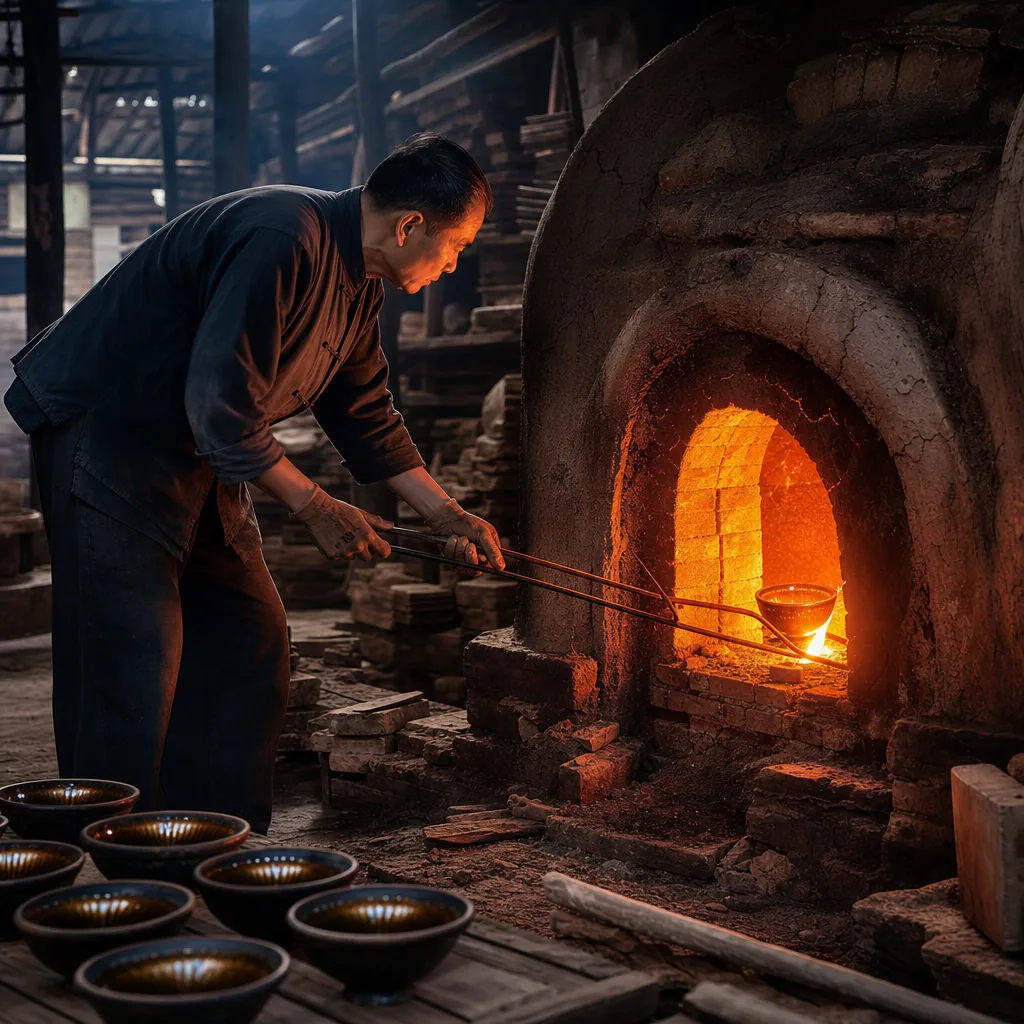
Jian ware must be fired in a reduction atmosphere at over 1,300°C. If the kiln is too cool, the glaze never fully melts. If it is too hot, the crystals are blown apart. If the atmosphere shifts toward oxidation, the glaze turns brown rather than blue-black.
This was a demanding, experience-intensive craft, and the rate of successful firings was historically low. Even Tian Gong Kai Wu, the great Ming dynasty technical encyclopedia, notes that the very best tea wares are "one in a hundred."
3. Three Classical Patterns of Jian Ware
The patterns on a Song Jian bowl were never drawn by hand. They are the natural crystallization of iron in the glaze under specific firing conditions. Different temperatures, different reduction conditions, and different cooling rates produce entirely different surfaces.
3.1 Hare's fur (tu hao)
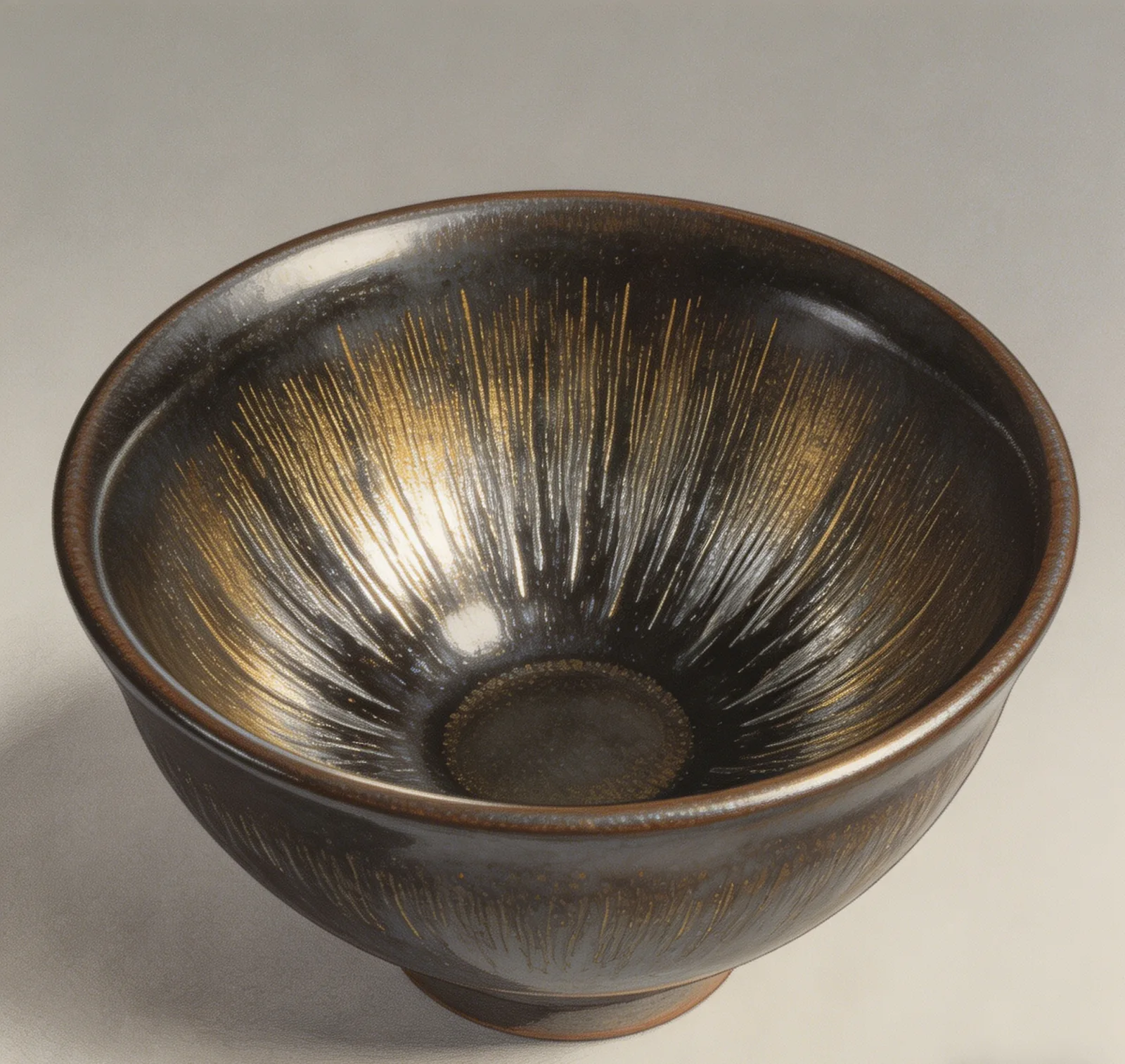
Hare's fur is the most common and most iconic pattern. Fine silvery threads rise from the foot of the bowl toward the rim, evoking the hairs on a hare's pelt. There are silver, gold, and bluish variants.
Song writers loved them. The poet Huang Tingjian wrote:
— Huang Tingjian, 'Manting Fang: Tea'A precious bowl of hare's fur and golden threads, fresh tea boiled until the water hisses like pine wind.
3.2 Oil spot (you di)
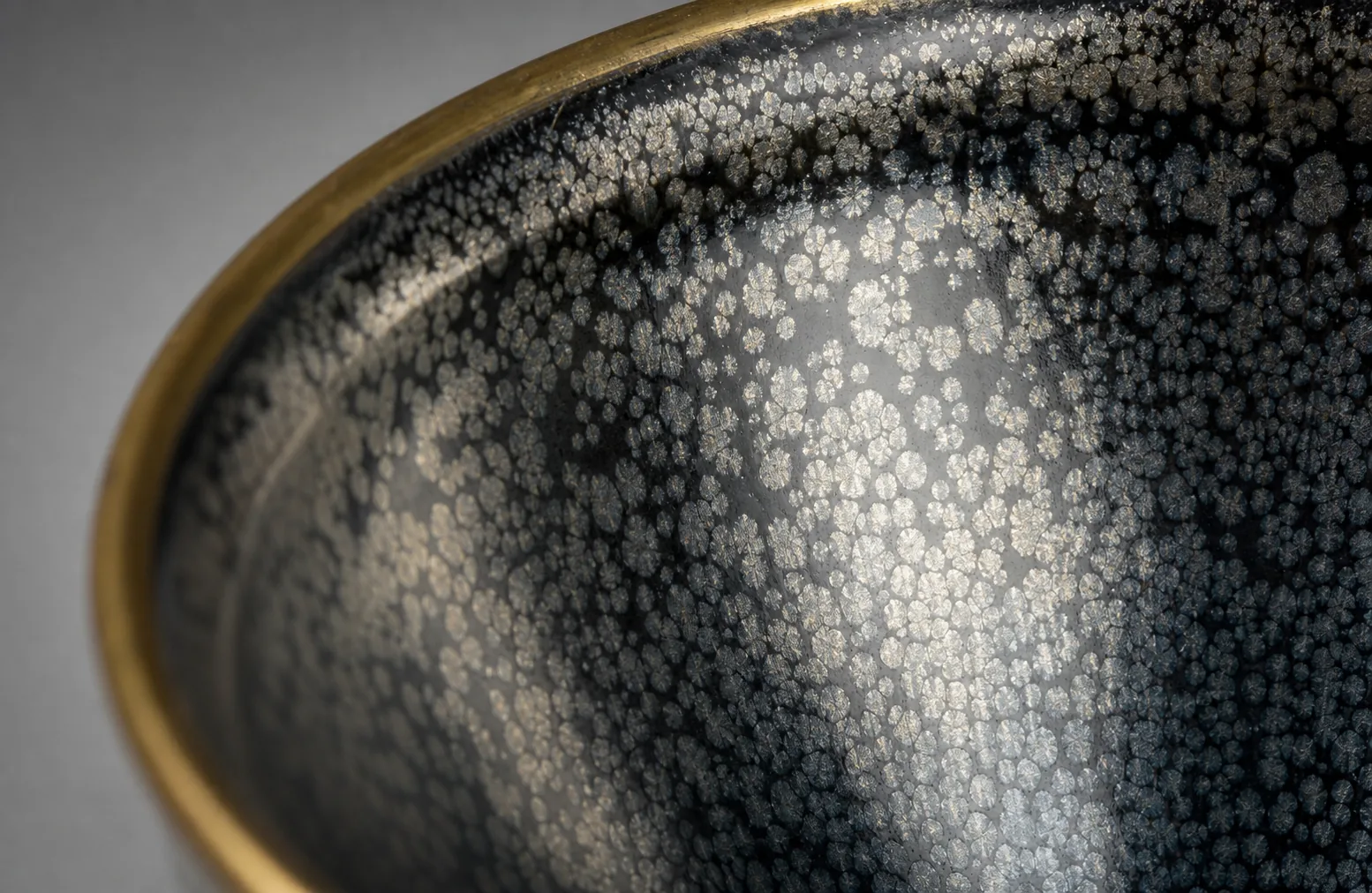
Oil spot patterns scatter rounded silvery or iridescent dots across the dark glaze, like beads of oil on water. They are harder to fire than hare's fur because the size and distribution of the crystals must be tightly controlled.
The oil spot bowl held by the Museum of Oriental Ceramics in Osaka is widely regarded as the finest surviving example.
3.3 Yohen tenmoku (yao bian)
Yohen tenmoku is the rarest type of Jian ware. The glaze carries patches of iridescent halos that shift through blues, violets, and greens depending on the angle of light. The effect resembles the cosmos compressed into a tea bowl.
The world currently recognizes only three intact yohen tenmoku bowls, all in Japan: Seikadō Bunko Art Museum (Tokyo), Fujita Art Museum (Osaka), and Ryōkō-in at Daitokuji (Kyoto). No intact specimen has yet been discovered in mainland China; only fragments have been excavated, including a half bowl found at the imperial palace site in Hangzhou.
Yohen is rare because its formation conditions are still not fully reproducible. Even with modern kiln technology, contemporary potters can only approximate the effect, not match it exactly.
4. Jian Ware and Japan: How "Tenmoku" Became a Global Symbol
4.1 Where the name tenmoku comes from
Tenmoku is the Japanese term for black-glazed tea bowls of this family. The name comes from Tianmu Mountain in Zhejiang. During the Kamakura period (twelfth and thirteenth centuries), Japanese monks who came to study Chan Buddhism in monasteries near Tianmu brought back the black bowls they had used there. Japanese culture eventually came to call all such bowls tenmoku.
In strict Japanese usage, tenmoku covers a wider range of black-glazed wares than Jian alone (it includes products from the Jizhou kilns, for example). But the most prized of the tenmoku family is, in practice, Song Jian ware.
4.2 The three yohen tenmoku bowls all live in Japan
The status of Jian ware in Japan exceeds its status in China. The yohen tenmoku bowls are designated National Treasures and are exhibited only briefly each year. Their survival is the work of the Japanese tea ceremony, which protected exceptional bowls across many generations.
By the time Sen no Rikyū consolidated the Japanese tea ceremony in the sixteenth century, Jian ware — and tenmoku in particular — was already the highest level of host-and-guest tea ware.
4.3 A cultural inversion
This produces a strange historical inversion. Jian ware was lost in mainland China for centuries after the Ming abolished cake-tea tribute and whisked tea collapsed. Yet the very best surviving examples were preserved abroad. From the late twentieth century onward, Chinese ceramics scholars have had to travel to Japan to study, compare, and reconstruct the lost technique.
5. Jian Ware Today: Revival, Collecting, and Common Mistakes
5.1 The slow road back to the kiln
After the late Song and early Yuan, the Jian kilns went cold. In 1979, Fujian organized a research team to revive Jian ware production. Decades of work have gradually solved the major technical problems: temperature control, glaze composition, reduction atmosphere. Modern Jianyang now hosts a range of producers, from mass-market kilns to dedicated craftsmen working at the high end.
5.2 Renewed international collecting interest
International interest in Song ceramics has grown in the past decade. In 2016, an oil spot tenmoku bowl from the Linyushanren collection sold at Christie's New York for over 11.7 million USD — the highest publicly recorded price for Jian ware. That sale pushed Jian ware further into the center of global collecting attention.
5.3 Common misconceptions
- Not every black tea bowl is a Jian ware bowl. Jian ware has a specific origin, clay body, and glaze chemistry. Black-glazed bowls from related kilns (Jizhou, Cizhou) are not Jian ware, even when they look similar.
- Not every Jian bowl has hare's fur. Both early and late Jian production includes plain black or "raven gold" glaze without crystalline patterns.
- Modern reproductions are not Song originals. The technique is now close, but the specific iron-rich red soils of Song-era Shuiji are no longer fully available. Some qualities of the originals cannot be perfectly reproduced.
Sources
- Cai Xiang, Cha Lu (Record of Tea), c. 1051
- Emperor Huizong (Zhao Ji), Da Guan Cha Lun (Treatise on Tea of the Daguan Era), 1107
- Zhu Mu, Fang Yu Sheng Lan, "Jianning Prefecture," Southern Song
- Song Yingxing, Tian Gong Kai Wu, "Pottery," 1637
- Huang Tingjian, "Manting Fang: Tea"
Classical Sources
- 📜 Cha Lu (Record of Tea)
- 📜 Da Guan Cha Lun (Treatise on Tea of the Daguan Era)
- 📜 Fang Yu Sheng Lan