Longjing: From Imperial Tribute to National Treasure
Introduction
At the foot of Shifeng Mountain, southwest of Hangzhou's West Lake, tea gardens sit wrapped in mist each spring. Pickers move through the rows, selecting tender buds one by one. The leaves are then passed to local craftsmen who shape them in iron pans through a technique called huiguo — a slow, low-temperature finishing that gives Longjing its signature flat form and layered aroma.
West Lake Longjing is one of China's most celebrated green teas. Its history reaches back to the Tang dynasty, its reputation grew during the Song, it became an imperial tribute under the Qing, and in 1972 it served as a national gift when Premier Zhou Enlai presented a tin of Longjing to visiting US President Richard Nixon.
How did a single tea come to carry so much cultural weight?
1. Terroir: Why West Lake?
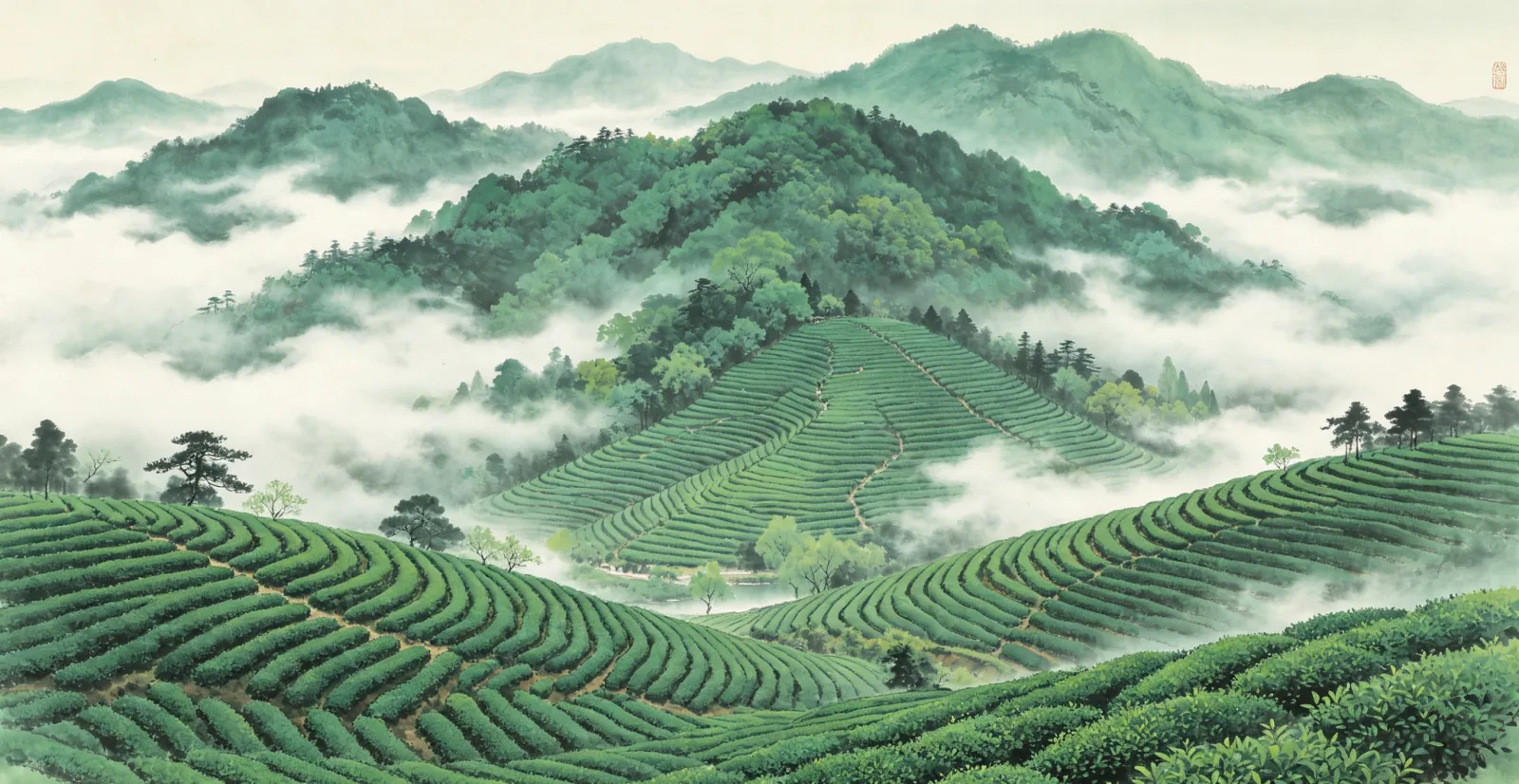
Longjing's core production area lies in the hills surrounding West Lake in Hangzhou — traditionally known by five place-names: Shifeng, Longjing, Yunqi, Hupao, and Meijiawu.
What makes this area distinctive?
| Factor | Effect on the Tea |
|---|---|
| Climate | Subtropical monsoon: warm, humid, abundant rainfall |
| Soil | Sandy yellow earth with gravel — well-drained and aerated |
| Terrain | Surrounding hills trap moisture and diffuse sunlight, promoting amino acid accumulation |
| Temperature | Cool spring temperatures slow leaf growth, concentrating flavor in small, tender buds |
These conditions together produce Longjing's characteristic freshness, sweetness, and high fragrance — what the trade calls its yun, or resonance.
2. A Brief History: Tang Through Qing
2.1 Tang dynasty: a tea-producing region
Hangzhou appears in the tea record as early as the Tang dynasty. Lu Yu's Classic of Tea lists the "Western Zhejiang" circuit among tea-producing areas, a region that included Hangzhou. At the time, however, Jingshan tea from nearby Yuhang held greater renown.
2.2 Song dynasty: rising reputation
The Song period brought significant growth to Hangzhou's tea culture. Chan Buddhist tea culture flourished, and the "Jingshan Tea Gathering" at Jingshan Temple became one of the early sources for Japanese tea ceremony. Hangzhou's "Baolin tea" — a precursor to what we now call Longjing — began to emerge during this era.
2.3 Ming dynasty: Longjing takes shape
The Ming dynasty marked a turning point in Chinese tea history. Emperor Zhu Yuanzhang abolished the tribute system for compressed tea cakes, and loose-leaf tea production expanded rapidly. It was during this period that Longjing's distinctive pan-fired huiguo technique developed, and literati such as Xu Wei praised Longjing in their writings. The reputation of "Hangzhou's finest tea" took hold.
2.4 Qing dynasty: imperial tribute
— Legend and Qiantang County GazetteerEmperor Qianlong visited Hangzhou repeatedly, personally observed Longjing tea picking, and designated eighteen tea trees before Hugong Temple as "Imperial Tea Trees."
With this imperial endorsement, Longjing's status was sealed. It became a formal tribute tea, and its prestige — and price — rose accordingly.
3. The Craft: How Longjing Is Made
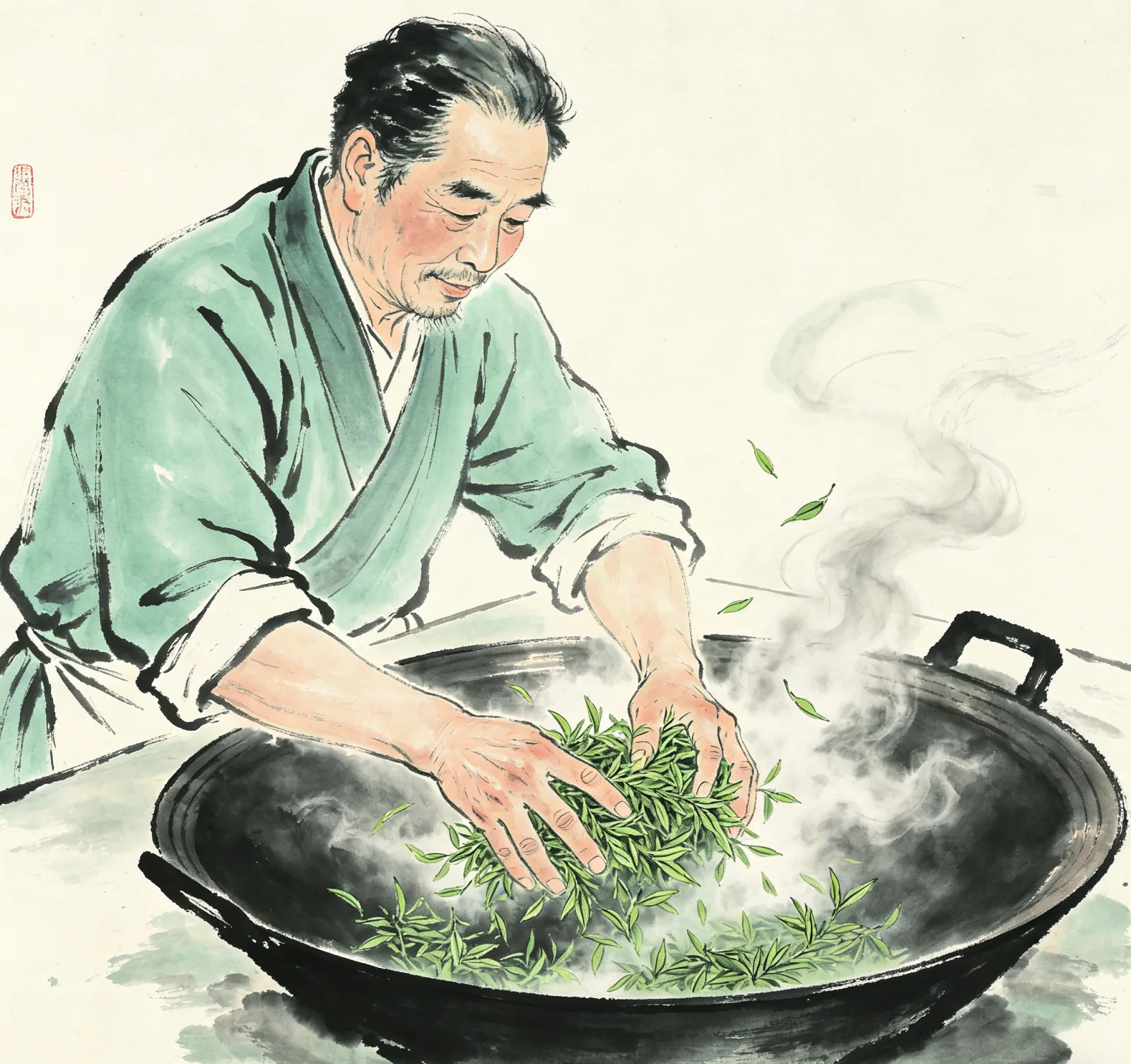
Longjing's flat shape and distinctive aroma come from its finishing step — huiguo, a slow pan-firing technique that is the soul of the craft.
Key steps
- Picking: Hand-harvested in early spring, one bud and one leaf
- Spreading: Fresh leaves are spread and allowed to wither naturally for 4–20 hours
- Initial firing (qingguo): High heat (140–150°C) to halt oxidation and fix the green color
- Resting: Leaves are cooled for 1–2 hours to redistribute moisture
- Finishing (huiguo): Low heat (80–120°C) for 15–20 minutes — shaping, drying, and developing aroma
- Pressing: Gentle pressure flattens the leaves into Longjing's characteristic form
The finishing step is where Longjing's flavor is built. At low temperature over extended time, amino acids and sugars undergo the Maillard reaction, producing the tea's signature chestnut, orchid, and toasted rice notes.
4. Tasting Longjing
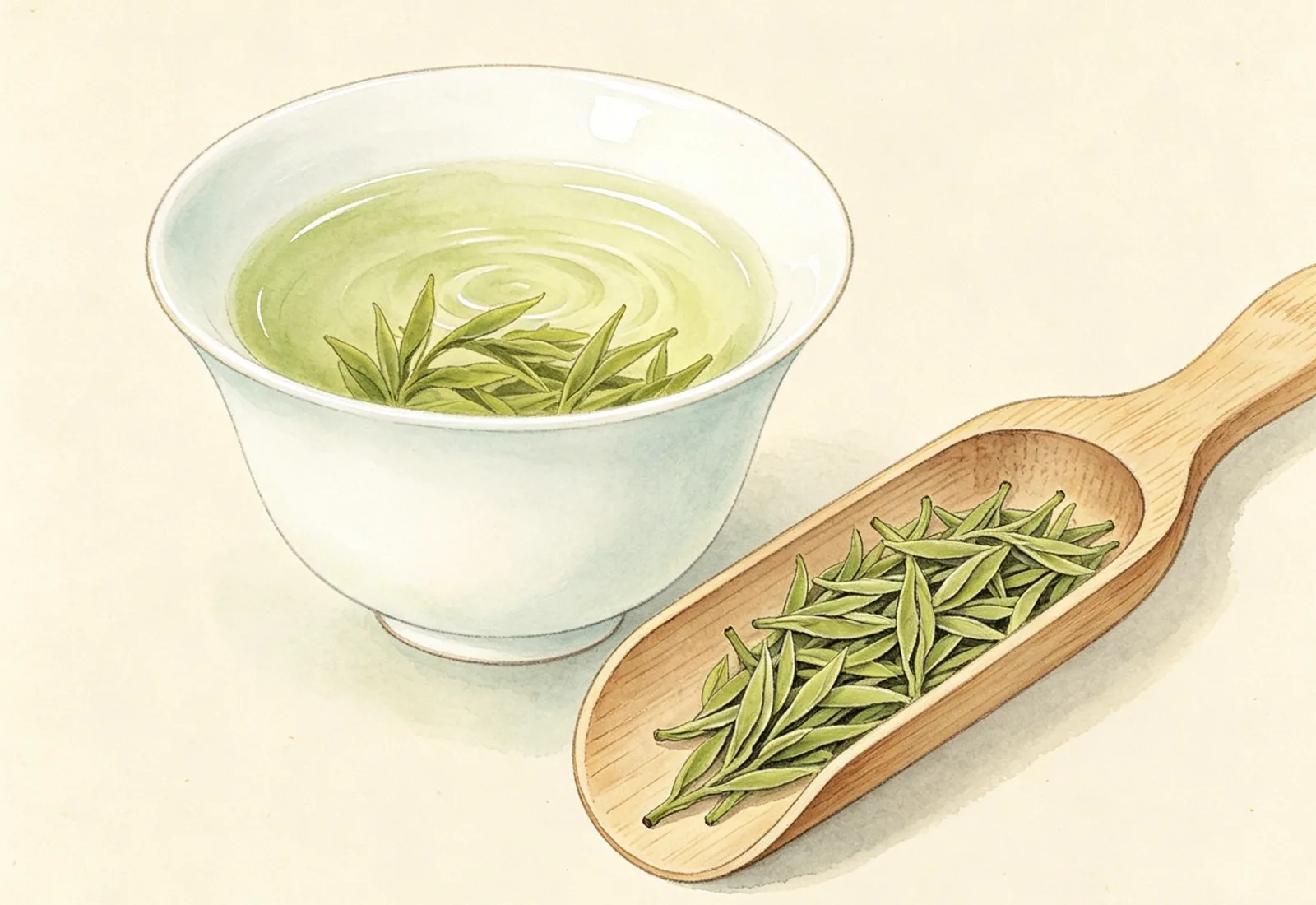
Appearance
| Grade | Characteristics |
|---|---|
| Supreme | Plump buds, flat and smooth, bright tender green |
| First | Full buds, flat and straight, green and lustrous |
| Second | Adequate buds, flat with tips, even green |
Liquor color
Pale yellow-green, clear and bright. If the liquor is dark, the tea was over-fired or is no longer fresh.
Aroma layers
- Tender fragrance: the fresh scent of the living plant
- Chestnut note: from pan-firing — the most characteristic marker
- Orchid note: found in premium Longjing, especially from Shifeng Mountain
Taste
The first sip should be fresh and sweet, with what Chinese tasters describe as "melting on the tongue." A well-made Longjing has gugen — a sense of structure and substance in the liquor, as opposed to thinness.
5. Buying and Brewing
Buying guidance
| Question | Advice |
|---|---|
| What price is reasonable? | Authentic West Lake Longjing retails at roughly 800–3,000 RMB per jin (500g); anything under 500 RMB is unlikely to be from the core production area |
| When to buy? | Pre-Qingming Longjing is the finest but most expensive; Pre-Guyu offers better value for daily drinking |
| How to verify? | Look for the "West Lake Longjing" geographical indication certification |
Brewing guide
| Parameter | Recommendation |
|---|---|
| Leaf amount | 3–4 grams |
| Water temperature | 75–80°C (not boiling) |
| Water volume | 150–200 ml |
| Steeping time | 1–2 minutes; can re-steep 3–4 times |
| Vessel | A straight glass cup is ideal — it lets you watch the leaves unfurl |
6. Longjing as Cultural Symbol
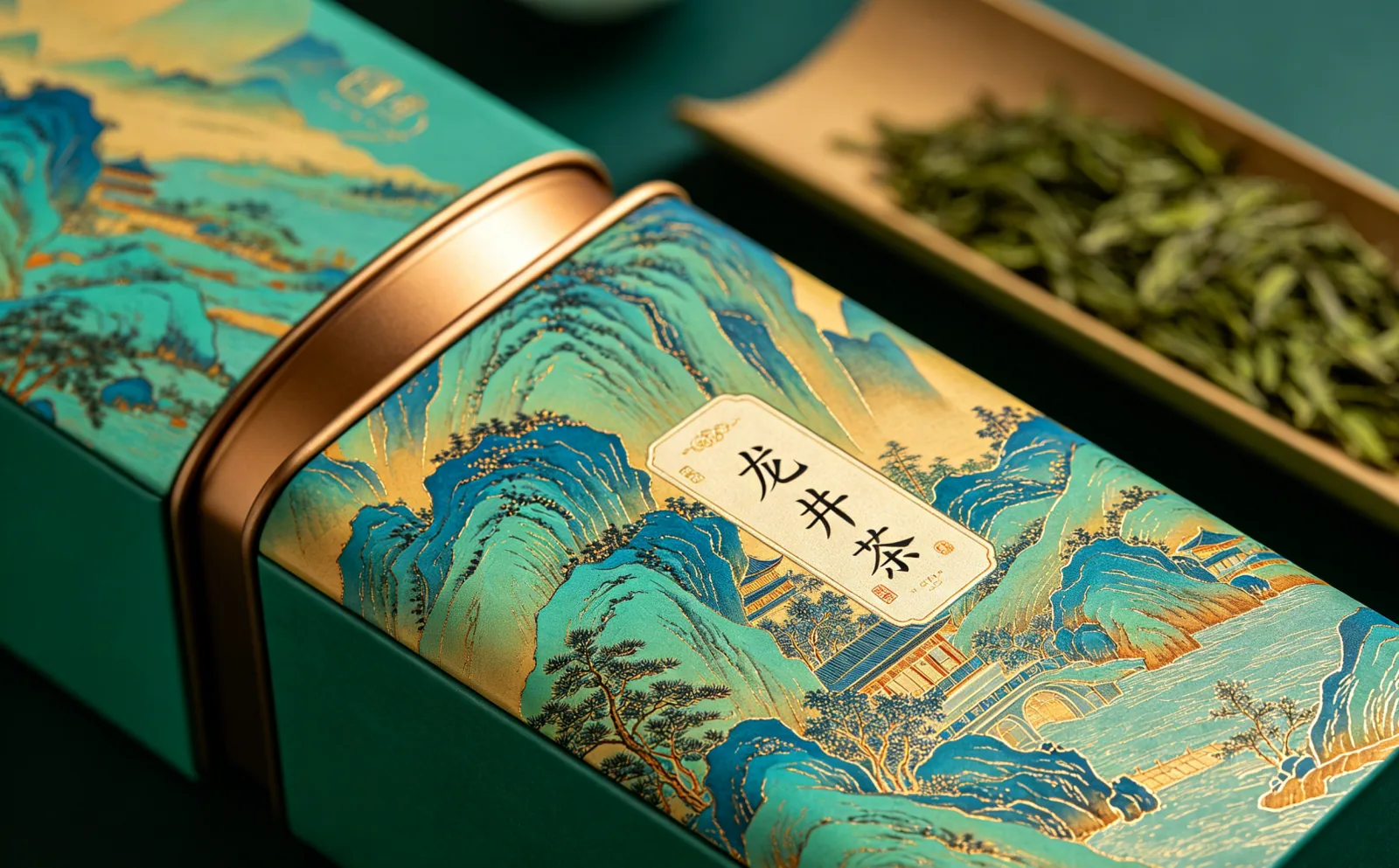
Longjing's standing among Chinese teas rests not only on flavor. It carries multiple layers of cultural meaning:
- Literati symbol: Poems by Su Dongpo and Emperor Qianlong bound Longjing to West Lake in the cultural imagination
- Diplomatic symbol: Its role as a national gift during the Nixon visit gave it international political significance
- Lifestyle symbol: Teahouses, slow living, and scholarly gatherings — Longjing is inseparable from Hangzhou's identity as a city of leisure
- Craft symbol: The huiguo technique represents a pinnacle of Chinese green tea craftsmanship, now recognized as national intangible cultural heritage
Sources
- The Classic of Tea (Cha Jing), Lu Yu, late eighth century
- Cha Jing, "Producing Regions"
- Daguan Chalun (Treatise on Tea), Emperor Huizong of Song, 1110
- Qiantang Xianzhi (Qiantang County Gazetteer), Qing dynasty
Classical Sources
- 📜 The Classic of Tea
- 📜 Treatise on Tea by Emperor Huizong
- 📜 Qiantang County Gazetteer