The Six Tea Families: Why Green Tea Is the Best Starting Point
Introduction
Longjing, Biluochun, Da Hong Pao, Tieguanyin, Pu'er, Keemun — these teas look nothing alike. Some are bright green, others dark brown or deep red. Their flavors range from grassy freshness to earthy depth.
Yet they all come from the same plant: Camellia sinensis.
What makes them different is not the plant, but what happens after the leaf is picked. Chinese tea is classified into six basic families based on processing method and degree of oxidation: green, white, yellow, oolong, black, and dark tea. Together, these six families account for virtually all traditional Chinese teas.
Among them, green tea is the oldest, the most widely consumed, and the most natural place to begin.
1. The Six Tea Families at a Glance
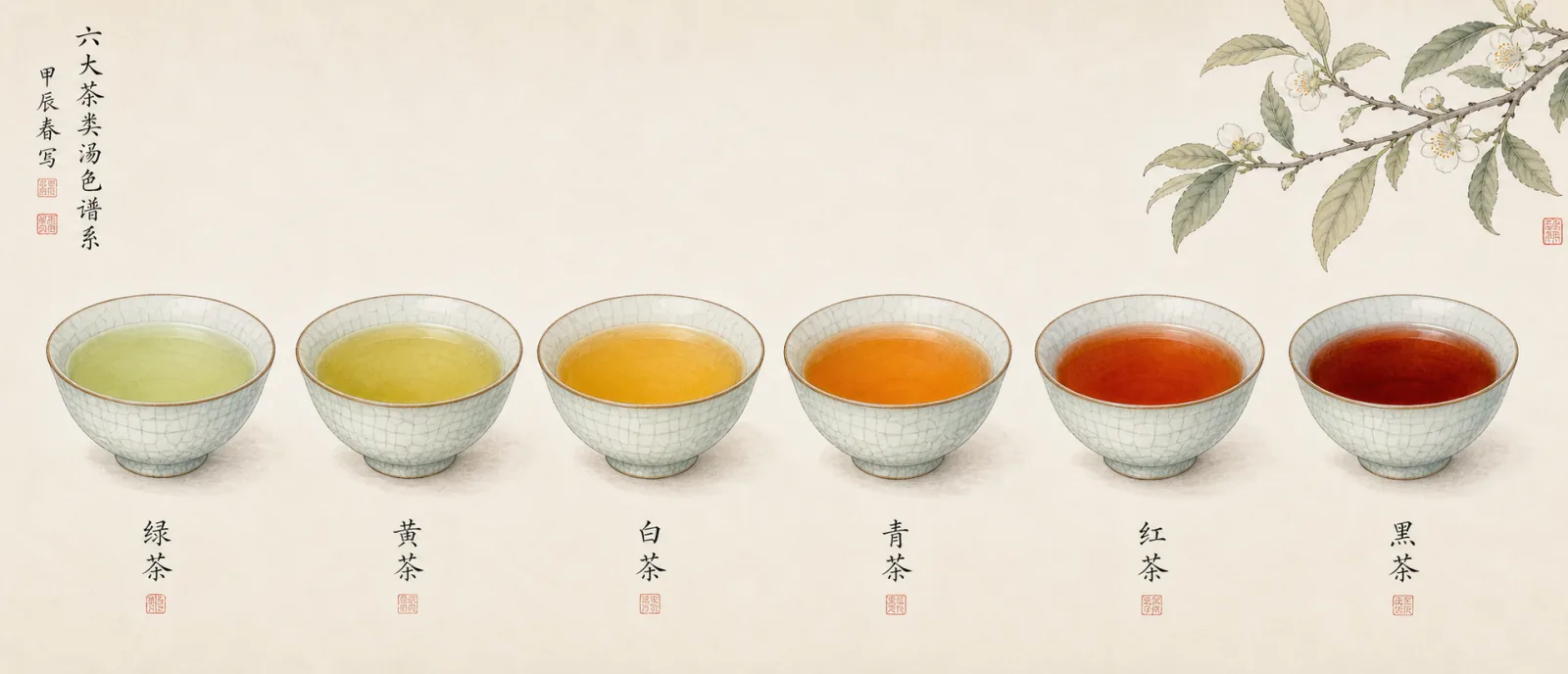
| Family | Oxidation | Core Process | Notable Examples | Character |
|---|---|---|---|---|
| Green | None | Kill-green → roll → dry | Longjing, Biluochun | Fresh, light, vegetal |
| White | Slight | Wither → dry | Silver Needle, White Peony | Delicate, sweet |
| Yellow | Slight | Kill-green → seal-yellow → dry | Junshan Silver Needle | Mellow, smooth |
| Oolong | Partial | Wither → shake → kill-green → roll → dry | Tieguanyin, Da Hong Pao | Aromatic, complex |
| Black (Red) | Full | Wither → roll → oxidize → dry | Keemun, Lapsang Souchong | Rich, sweet |
| Dark | Post-fermented | Kill-green → roll → pile-ferment → dry | Ripe Pu'er, Liu Bao | Smooth, earthy |
The relationship is straightforward: the same leaf, taken through different processing paths, becomes a fundamentally different tea. Understanding this principle is the key to the entire Chinese tea system.
2. Why Start with Green Tea?
2.1 It is closest to the leaf itself
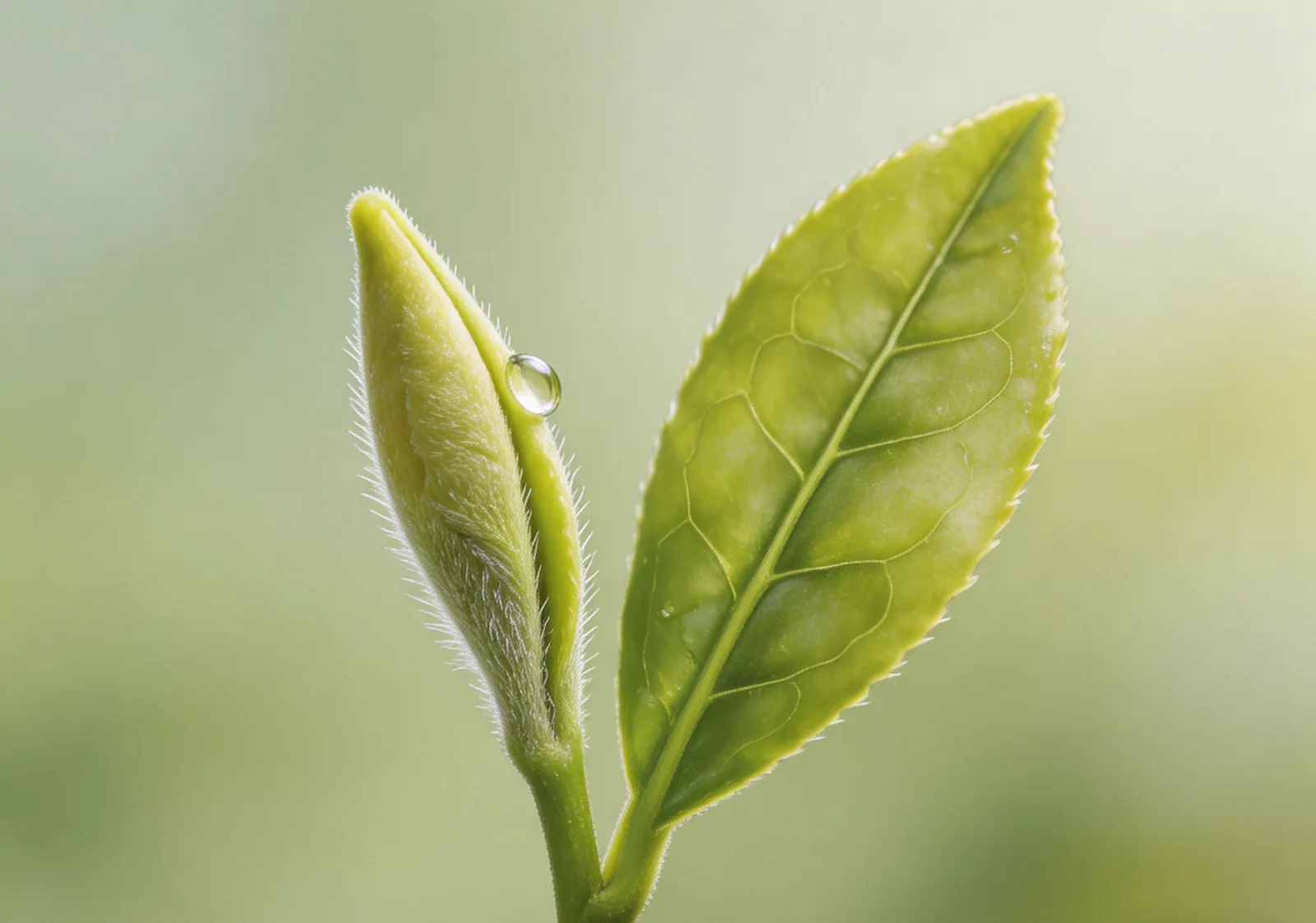
Green tea is unoxidized. Immediately after picking, the fresh leaves are heated — either by pan-firing or steaming — to halt oxidation. This preserves the leaf in something close to its original state:
- Color remains green, not the reddish-brown of oxidized teas
- Flavor is fresh and direct, without the complexity that fermentation introduces
- Aroma is vegetal and clean, rather than malty or earthy
For someone beginning to explore tea, green tea offers the most unmediated encounter with the leaf itself.
2.2 It is globally familiar
Green tea is likely the first Chinese tea most people encounter. Japanese matcha, green tea lattes, and green tea health products have given it worldwide recognition. A beginner does not need specialized knowledge to approach it — there is already a frame of reference.
2.3 It is forgiving to prepare
Green tea requires no elaborate equipment. A glass cup or a simple lidded bowl, water cooled to around 80°C, and one to two minutes of steeping produce a good result.
| Factor | Green Tea | Oolong / Black Tea |
|---|---|---|
| Water temperature | 70–80°C | 85–100°C |
| Steeping time | 1–2 minutes | Up to 5+ minutes |
| Equipment | Any cup | Sometimes requires gongfu set |
3. Two Processing Traditions within Green Tea
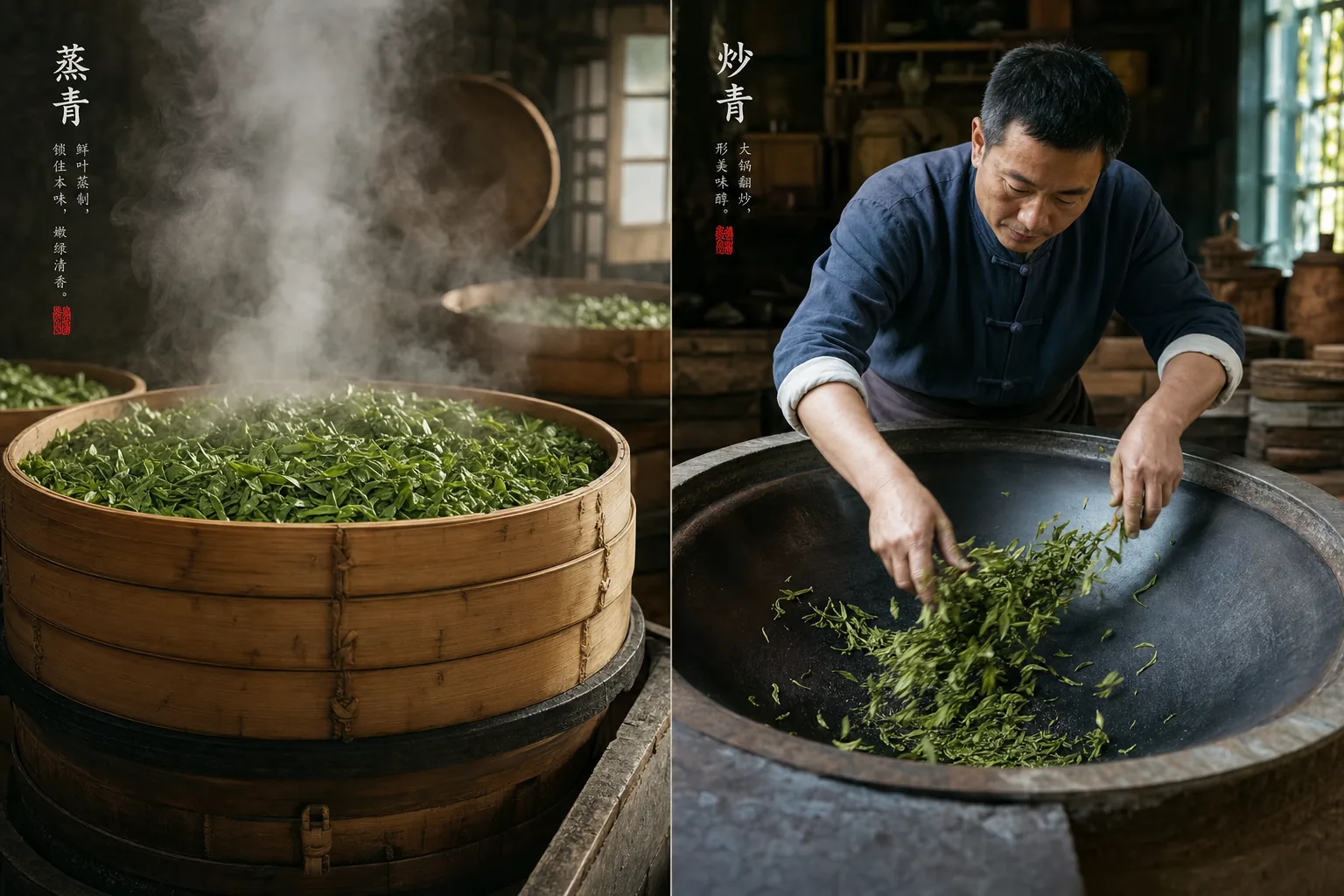
Not all green teas are made the same way. The method used to halt oxidation — the "kill-green" step — divides green tea into two major traditions.
3.1 Steamed green tea
- Process: Steam the fresh leaves → roll → dry
- Examples: Japanese gyokuro, sencha, and matcha (all descended from Chinese Tang-Song methods)
- Character: Brighter green color, more delicate and vegetal flavor
- History: This was the dominant method during the Tang dynasty, the method Lu Yu described in The Classic of Tea
— Cha Jing, 'Making'When the weather is fair: pick, steam, pound, press, bake, string, and seal — thus tea is dried.
3.2 Pan-fired green tea
- Process: Roast the fresh leaves in a hot pan → roll → dry
- Examples: Longjing, Biluochun, Xinyang Maojian
- Character: More pronounced aroma (Maillard reaction produces toasty, nutty notes)
- History: Became the mainstream method after the Ming dynasty, when Emperor Zhu Yuanzhang abolished compressed tea tribute
Today, pan-fired green tea dominates in China, while Japan preserved the Tang-dynasty steaming tradition and developed it into its own refined practice.
4. Three Things to Know When Choosing Green Tea
4.1 Pre-Qingming vs. Pre-Guyu
| Category | Harvest Window | Character | Price |
|---|---|---|---|
| Pre-Qingming | Before early April | Smallest, most tender buds | Highest |
| Pre-Guyu | Before mid-April | One bud, one leaf; fuller flavor | Moderate |
Pre-Qingming tea is prized because cool spring temperatures slow leaf growth, concentrating flavor in tiny, tender buds. But Pre-Guyu tea often offers a richer taste at a more accessible price — a better everyday choice for most drinkers.
4.2 Origin matters
China's most celebrated green teas are named for where they grow:
- West Lake Longjing — Hangzhou, Zhejiang: chestnut and orchid notes
- Biluochun — Dongting Mountain, Suzhou: fruit and floral fragrance
- Xinyang Maojian — Henan: chestnut aroma, highland character
- Huangshan Maofeng — Anhui: sweet, mellow freshness
- Anji Baicha — Huzhou, Zhejiang: exceptionally high amino acid content, pure freshness
4.3 Freshness is essential
Green tea is a drink of the current year. Unlike Pu'er or some oolongs, it does not improve with age. Buy the current spring harvest, and pay attention to the production date.
5. Brewing Green Tea Well
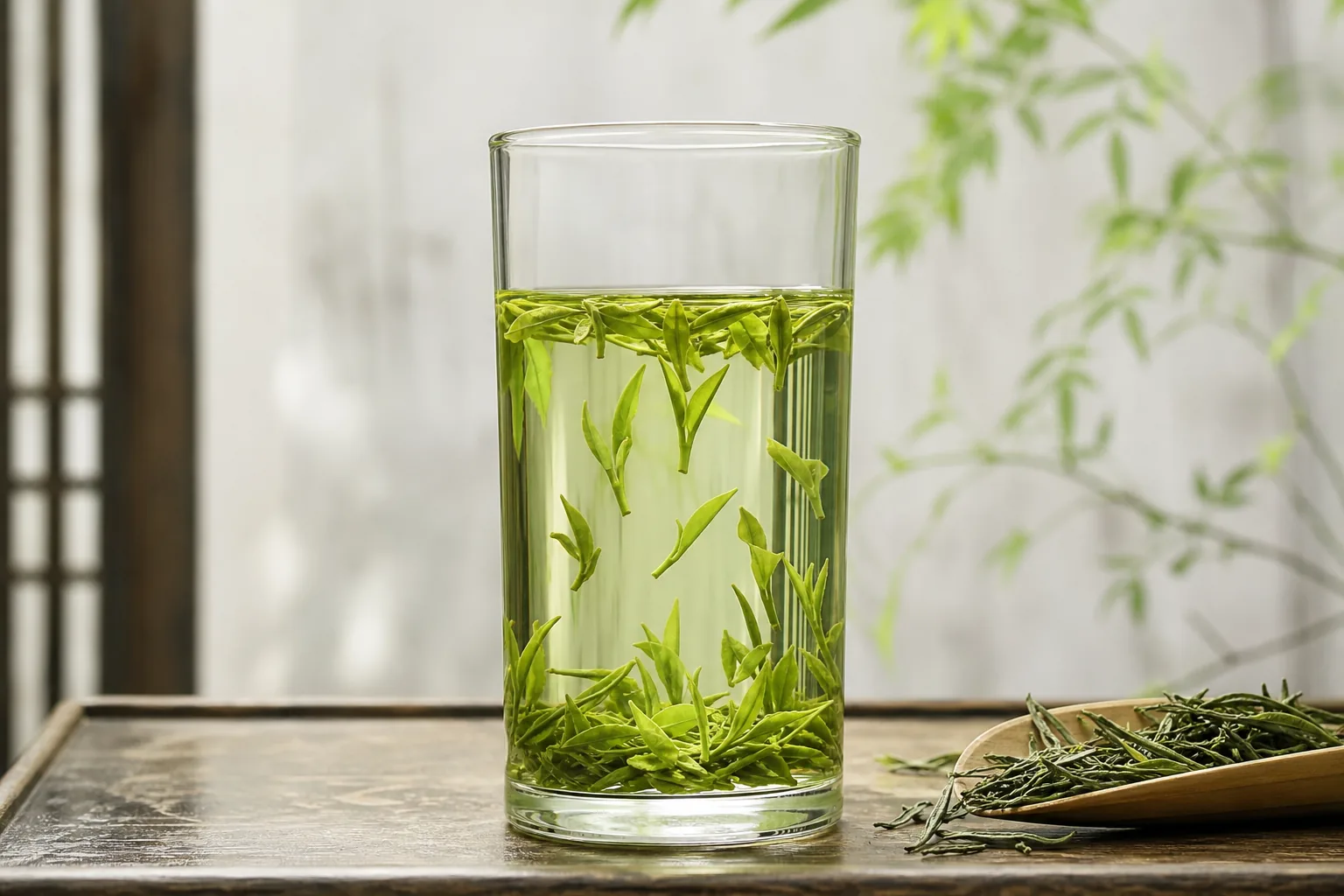
| Parameter | Recommendation |
|---|---|
| Leaf amount | 3–5 grams |
| Water temperature | 70–80°C (not boiling) |
| Water volume | 150–200 ml |
| Steeping time | 1–2 minutes |
| Re-steeps | 2–3 times, extending duration gradually |
The most common mistakes:
- Boiling water scorches the leaves, producing bitterness — let the water cool for a minute or two after boiling
- Over-steeping extracts harsh tannins — keep it under two minutes for the first infusion
- Using a thermos traps heat and over-cooks the tea — use an open glass or lidded bowl, and drink promptly
Sources
- The Classic of Tea (Cha Jing), Lu Yu, late eighth century
- Cha Jing, "Making"
- Daguan Chalun (Treatise on Tea), Emperor Huizong of Song, 1110
- Encyclopedia of Chinese Tea, Chen Zongmao and Yang Yajun, 1992
Classical Sources
- 📜 The Classic of Tea
- 📜 Treatise on Tea by Emperor Huizong