Cha Jing: What the World's First Tea Book Really Says
Introduction
Around 760 CE, a young recluse named Lu Yu was living by Tiaoxi stream in Huzhou, Zhejiang, writing a book no one had asked for. He had spent years traveling through tea-producing regions, studying implements, interviewing farmers, and recording what he observed. The result was The Classic of Tea — the world's first treatise devoted entirely to tea.
The text is brief, roughly seven thousand characters in all. Yet its influence has been outsized. It gave tea a structure that could be studied and transmitted. It articulated a philosophy of tea that remains recognizable today. And it shaped not only Chinese tea culture, but contributed background conditions for tea traditions across East Asia.
1. Who Was Lu Yu?
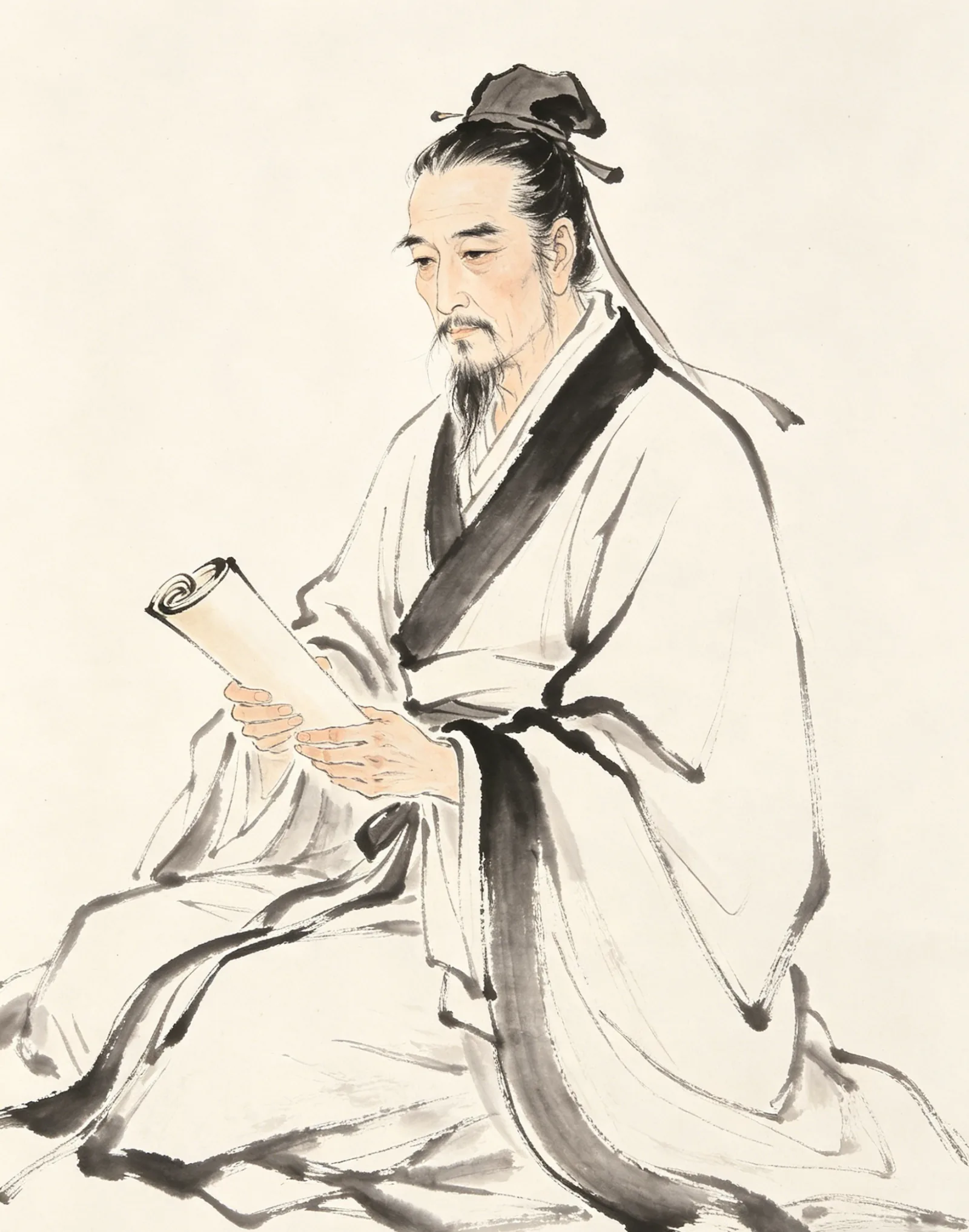
Lu Yu (733–804) was orphaned as a child and raised by the Buddhist monk Zhiji at Longgai Temple in Jingling, present-day Tianmen, Hubei. He refused monastic life, left the temple as a young man, and spent years in varied pursuits — including a period as a performer — before settling into the scholarly reclusion for which he is remembered.
What distinguished Lu Yu was his method. He did not write about tea from a library. He traveled to producing areas, examined water sources, observed preparation practices firsthand, and compared results. The Classic of Tea reflects this empirical temperament: it is organized by categories, attentive to specifics, and resistant to vague generalization.
Later generations gave him the title "Tea Sage" — placing him alongside Du Kang (the legendary inventor of wine) and Du Fu (the "Poetry Sage") in China's cultural pantheon.
2. The Structure of the Text
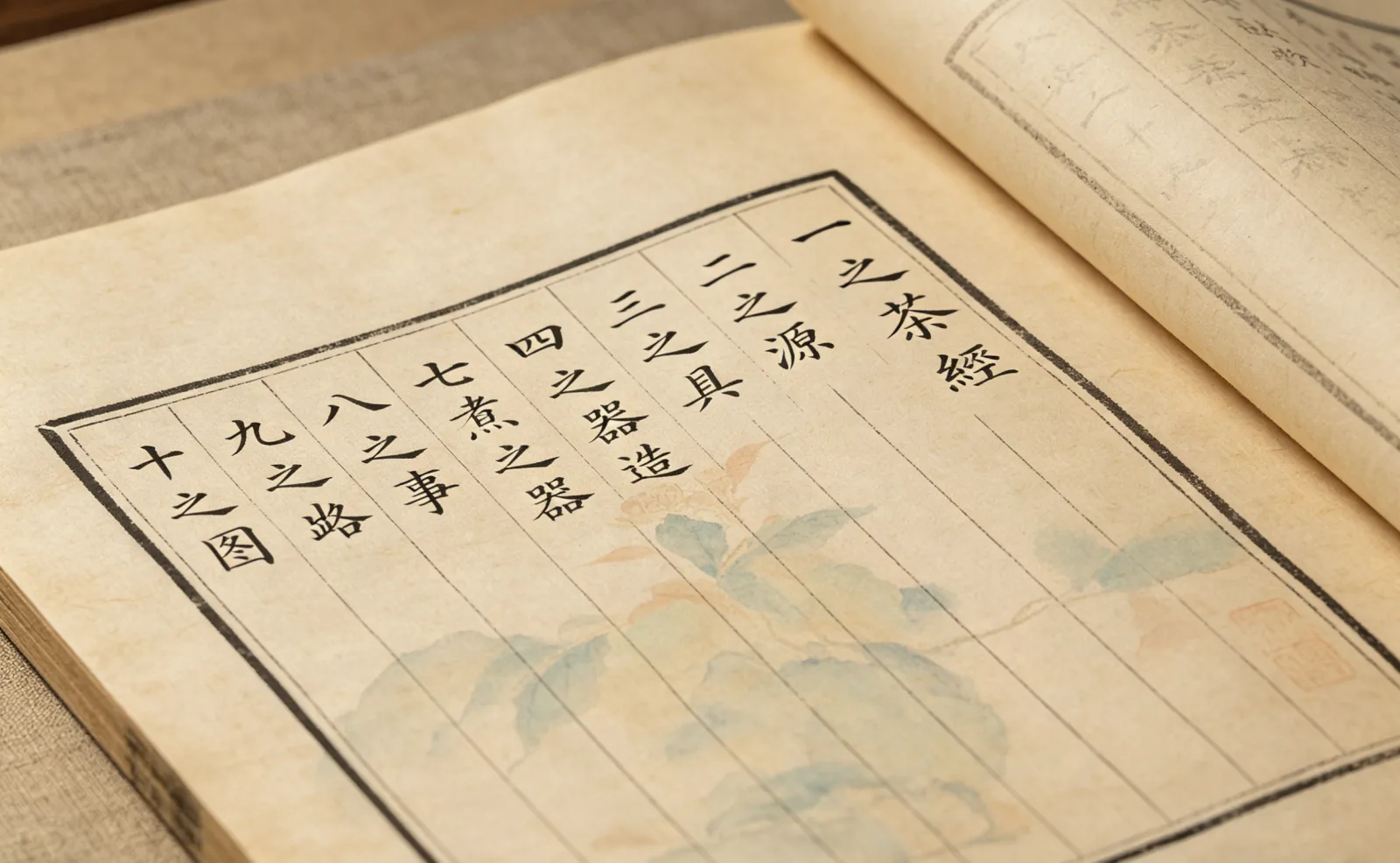
The Classic of Tea is divided into three volumes and ten chapters:
| Chapter | Subject | Key Idea |
|---|---|---|
| 1. Origins | Where tea comes from | "Tea is a magnificent tree of the south" |
| 2. Tools | Implements for harvesting and processing | 19 tools catalogued |
| 3. Making | How tea is manufactured | Timing of spring harvest matters |
| 4. Vessels | Implements for boiling and drinking | 28 vessels catalogued |
| 5. Boiling | How to prepare tea | Stages of boiling water as critical technique |
| 6. Drinking | The way of tea | "Refined conduct and frugal virtue" |
| 7. Records | Historical references to tea | From Shennong to the Tang |
| 8. Regions | Producing areas and quality rankings | 8 circuits, 43 prefectures evaluated |
| 9. Simplification | When tools can be reduced | Adapting practice to setting |
| 10. Diagram | The full text as a wall chart | For broader circulation |
These ten chapters form a complete arc: what tea is, how it is grown and made, what tools are used, how it is prepared and consumed, who has written about it before, where the best tea comes from, and how to adapt practice to circumstances.
3. The Central Idea: Refined Conduct and Frugal Virtue
The philosophical core of The Classic of Tea appears in the sixth chapter, "On Drinking":
— Cha Jing, 'On Drinking'Tea as a drink is most suitable for those of refined conduct and frugal virtue.
Two principles are embedded here.
Refined conduct (jingxing) means precision and care. Lu Yu specified exact requirements for tools, water temperature, quantities, and timing. Tea preparation, in his view, was not a casual act but one that demanded attentiveness.
Frugal virtue (jiande) means restraint and simplicity. The purpose of tea was not display or competition over expensive wares. It was about achieving satisfaction through discipline and economy.
Together, these two principles shaped the enduring character of Chinese tea culture: not grandeur, but depth; not luxury, but refinement.
4. On Water and Fire
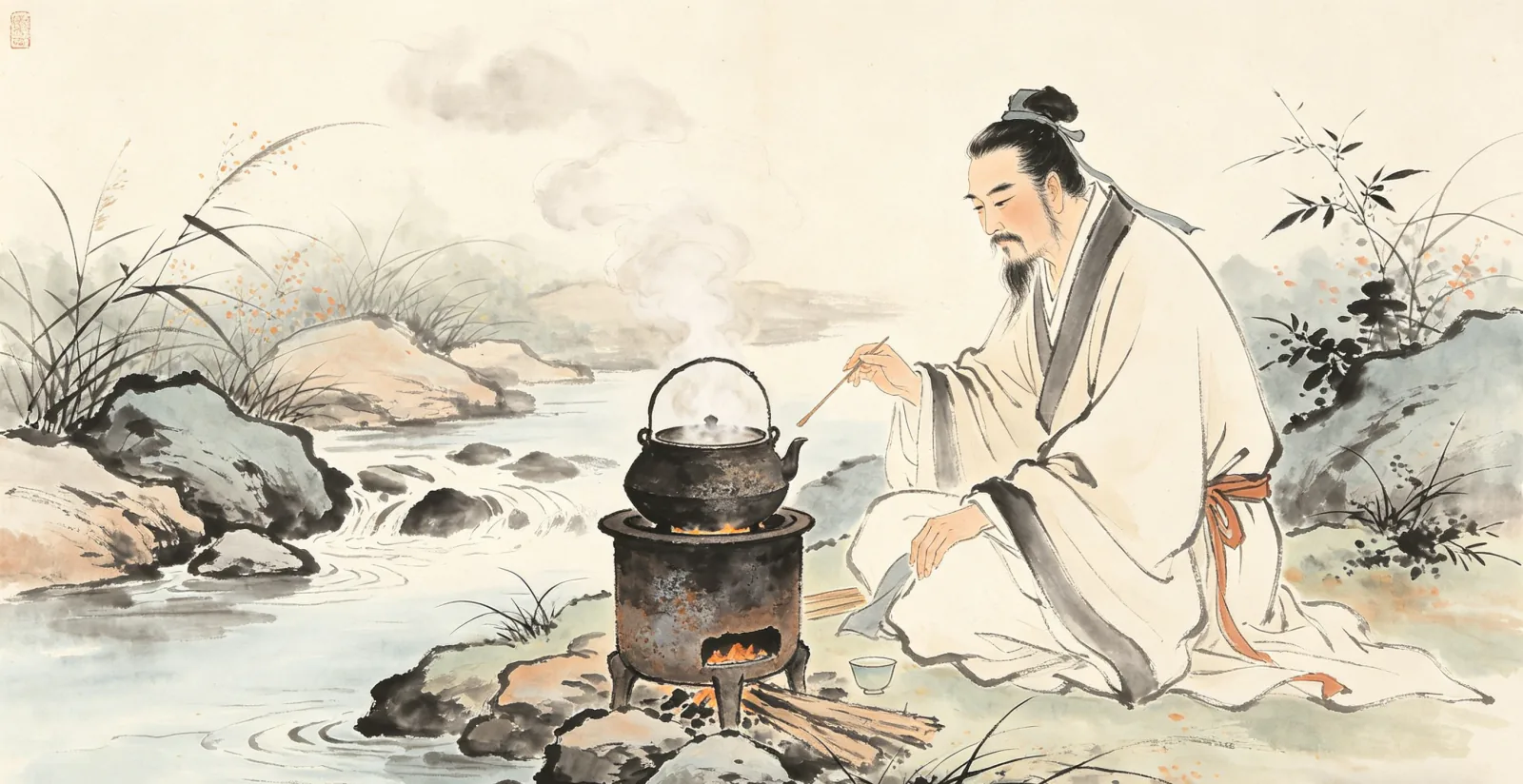
The ranking of water
— Cha Jing, 'Boiling'Mountain water is best, river water comes next, well water is lowest.
Lu Yu ranked water in three tiers. Mountain spring water, with its stable mineral content, was superior. River water, filtered by flow but vulnerable to contamination, came second. Well water, often too hard, was least desirable.
The three stages of boiling
He also described the boiling process with unusual precision:
- First boil (small bubbles like fish eyes): water just beginning to heat — add salt at this stage
- Second boil (springs rising at the edges): water fully rolling — add the tea powder
- Third boil (waves surging): water has become "old" — no longer suitable for tea
This is among the earliest documented attempts to describe boiling stages as a technical variable in food preparation.
5. On Vessels: The Case for Yue Ware Celadon
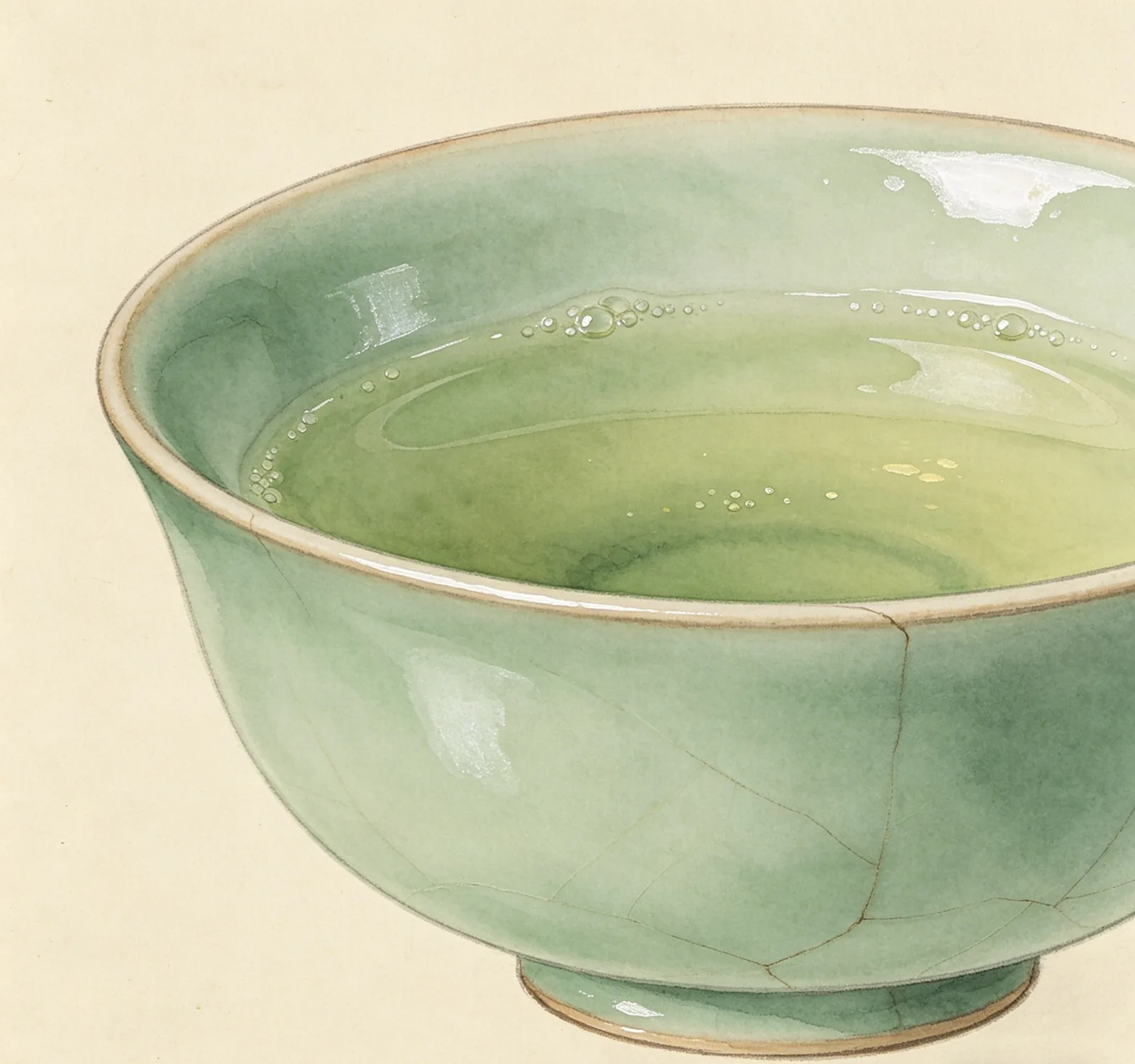
Chapter four catalogues twenty-eight types of tea vessels. The most celebrated passage concerns Lu Yu's preference for Yue ware celadon:
— Cha Jing, 'Vessels'For bowls, Yue ware is best... Yue porcelain is like jade, like ice.
"Like jade, like ice" — these two images capture the qualities Lu Yu prized: warmth and clarity, substance and translucence.
His reasoning was also practical. Green tea liquor, he observed, appeared most vivid and appealing in celadon bowls. The grey-green glaze harmonized with the green of the tea, producing visual pleasure that enhanced the experience of drinking.
This aesthetic judgment proved durable. Celadon remained central to Chinese tea culture for centuries, and the principle that vessel and liquid should work together visually became a lasting feature of East Asian tea aesthetics.
6. What the Text Left Behind
| Domain | Legacy |
|---|---|
| Philosophy | "Refined conduct and frugal virtue" became the spiritual core of Chinese tea culture |
| Aesthetics | Yue ware celadon set the standard for Tang tea vessels and influenced later traditions |
| Water knowledge | Established the practice of evaluating water quality as central to tea preparation |
| Tea geography | Chapter eight is the earliest systematic evaluation of Chinese tea-producing regions |
| East Asian transmission | Provided intellectual background for Japanese tea culture through monastic exchange |
The Japanese monk Eisai, who traveled to Song China in 1191, brought tea seeds and Song-dynasty whisked tea methods back to Japan. The four principles of Japanese tea — harmony, respect, purity, tranquility — are often read as an evolution of Lu Yu's earlier framework.
When you drink a bowl of matcha in a Japanese tea ceremony, you are drinking a distant descendant of Tang-dynasty decocted tea. The genealogy passes through The Classic of Tea.
Sources
- The Classic of Tea (Cha Jing), Lu Yu, late eighth century
- Cha Jing, "Origins"
- Cha Jing, "Vessels"
- Cha Jing, "Boiling"
- Cha Jing, "Drinking"
- Cha Jing, "Producing Regions"
- New Book of Tang, "Biography of Lu Yu"
Classical Sources
- 📜 The Classic of Tea
- 📜 New Book of Tang: Biography of Lu Yu